Staff Correspondent, Dhaka:
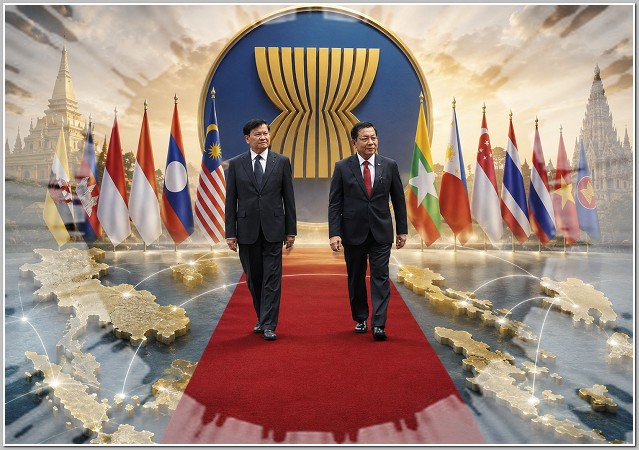
Myanmar’s military ruler Min Aung Hlaing has made his first official visit to an ASEAN member state as the country’s self-declared civilian president, marking a significant diplomatic milestone in Naypyidaw’s campaign to regain regional legitimacy despite continuing political and armed conflict at home.
Min Aung Hlaing arrived in Laos on Friday for a three-day state visit, where he is scheduled to meet President Thongloun Sisoulith and Prime Minister Sonexay Siphandone. The visit is his first bilateral trip to an ASEAN country since assuming the presidency in April following controversial elections widely criticized for excluding key opposition forces, including the party of detained former leader Aung San Suu Kyi.
The trip reflects Myanmar’s broader strategy of reframing its international image by presenting the current administration as a civilian government rather than a military junta. However, many regional observers argue that the political transition is largely symbolic, with Min Aung Hlaing—who led the 2021 military coup—remaining the country’s dominant decision-maker.
For ASEAN, the visit underscores growing divisions over how to engage with Myanmar. Since the coup, the regional bloc has largely isolated the military leadership by excluding it from high-level summits under its Five-Point Consensus aimed at restoring peace and dialogue. Yet, differing national interests are beginning to challenge that unified approach.
Some ASEAN members appear willing to cautiously re-engage, citing recent gestures by Myanmar’s authorities, including the decision to move the 81-year-old Aung San Suu Kyi from prison to house arrest. Supporters of engagement argue that sustained dialogue may offer greater leverage than continued isolation.
Others remain unconvinced, noting that the country’s civil war continues, democratic institutions have not been restored, and political opposition remains suppressed. From this perspective, formal diplomatic recognition risks legitimizing a government whose authority remains contested both domestically and internationally.
The Laos visit also follows Min Aung Hlaing’s recent trips to India and China, suggesting that Myanmar is gradually rebuilding external relationships despite Western sanctions and criticism.
Whether the visit represents the beginning of Myanmar’s reintegration into ASEAN or merely exposes widening divisions within the bloc will depend on how member states balance diplomatic engagement with their long-standing commitment to democratic principles and regional stability.