
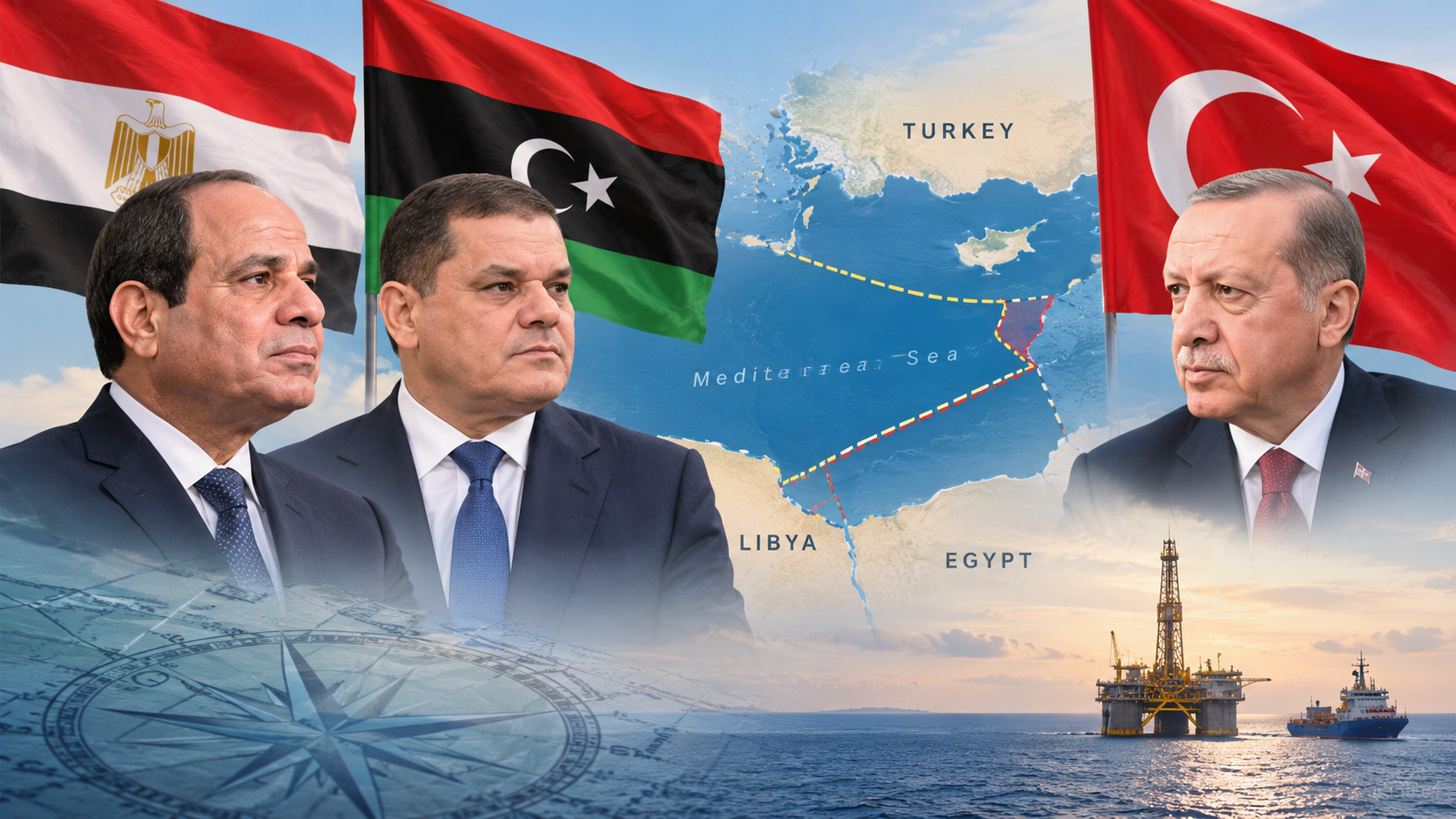
Libya’s willingness to discuss Egypt’s concerns offers a diplomatic opening, as Turkey’s maritime agreement with Libya renews tensions in the eastern Mediterranean.
By Anwar Shahadat, New York.
Shared religious, cultural, and historical ties do not always translate into agreement on national interests. The latest maritime dispute involving Egypt and Libya illustrates this reality, as two neighboring Muslim-majority countries face disagreements over maritime boundaries, economic interests, and regional partnerships. With Turkey at the center of the issue, the dispute also highlights the challenges of balancing regional cooperation with competing national priorities.
Libya’s internationally recognized Government of National Unity has indicated its willingness to address Egypt’s concerns through dialogue, following renewed controversy over the 2019 maritime agreement between Turkey and Libya. The development offers a possible opening for diplomacy, although significant differences remain.
The dispute intensified after Libya’s eastern-based House of Representatives approved the Turkey-Libya maritime agreement on October 20. Egypt rejected the move, maintaining that the parliamentary decision had no legal effect on its maritime rights.
Libyan Prime Minister Abdulhamid Dbeibah, who leads the Government of National Unity in Tripoli, subsequently expressed readiness to discuss Egypt’s concerns. Reports on October 24 indicated that the issue was raised during discussions involving Egyptian intelligence chief Hassan Rashad.
The willingness to engage provides an opportunity to ease tensions, but it does not mean that Egypt and Libya have reached an agreement. The scope of their differences and the terms of any potential settlement remain uncertain.
Competing Claims in the Eastern Mediterranean
The maritime agreement, signed in November 2019 by Turkey and Libya’s then-Tripoli-based Government of National Accord, established a framework for maritime jurisdiction between the two countries. It has faced opposition from Egypt, Greece, and Cyprus, which have raised objections based on their own maritime claims and regional interests.
Egypt has argued that maritime boundaries and rights to exclusive economic zones and continental shelves must be addressed in accordance with international law. Cairo also maintains that the eastern Libyan parliament’s approval cannot determine or diminish Egypt’s maritime rights.
Turkey, meanwhile, continues to defend the agreement while indicating a willingness to discuss Egypt’s concerns. Turkish Foreign Minister Hakan Fidan met his Egyptian counterpart, Badr Abdelatty, in Istanbul on October 23. The discussions included maritime issues and the importance of continued consultation.
Fidan also proposed dialogue involving Turkey, Egypt, Italy, and Libya to address questions concerning continental shelves and maritime rights. Such discussions could provide a broader diplomatic framework, although a lasting settlement would require the parties to address their competing legal positions and national interests.
The dispute is also complicated by Libya’s internal political divisions. The country has rival political centers in the east and west, and the eastern parliament’s approval does not necessarily represent a unified position across all Libyan institutions. The question of how Libya’s competing authorities approach the agreement therefore remains important to any future negotiations.
Regional Solidarity and National Interests
Beyond the legal and diplomatic details, the dispute raises a broader question about cooperation among Muslim-majority countries. Egypt, Libya, and Turkey share important historical and cultural connections, yet their governments pursue distinct national interests and maintain different regional partnerships.
Common religious or cultural ties cannot automatically resolve disagreements over maritime jurisdiction, offshore resources, or strategic influence. At the same time, such differences need not prevent dialogue or cooperation on matters of shared interest.
The current situation demonstrates the importance of diplomacy precisely because the countries involved have broader reasons to maintain stable relations. For Egypt, protecting maritime interests remains a priority. For Libya, managing relations with neighboring countries is connected to its wider political and economic stability. Turkey, meanwhile, continues to defend its regional maritime position while maintaining diplomatic engagement with Cairo.
Libya’s willingness to address Egypt’s concerns offers a possible path forward, but the outcome will depend on whether the parties can move from general expressions of dialogue to substantive negotiations. The positions of Libya’s rival institutions and the legal questions surrounding the agreement will remain central to that process.
For now, the development represents a diplomatic opening rather than a resolution. Whether shared regional interests can help bridge the differences will become clearer as discussions progress. The challenge for Egypt, Libya, and Turkey is to manage their competing claims without allowing the maritime disagreement to undermine wider regional cooperation.