Senior Correspondent, Dhaka:
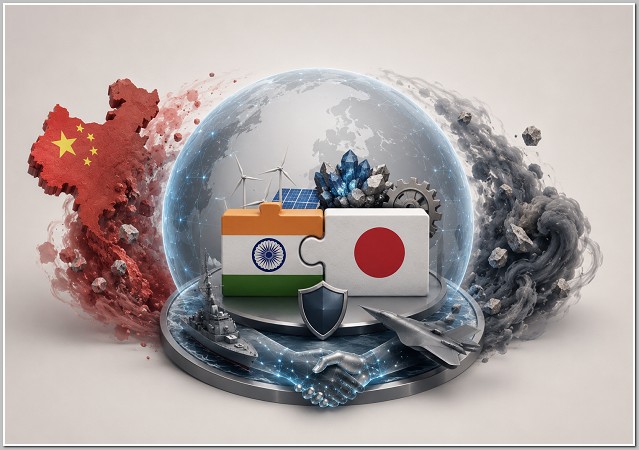
China has cautioned against the formation of exclusive strategic groupings after India and Japan unveiled a series of major agreements covering defense, critical minerals, energy security and economic cooperation, underscoring intensifying geopolitical competition in the Indo-Pacific.
Speaking at a regular press briefing in Beijing on Friday, Chinese Foreign Ministry spokesperson Guo Jiakun said cooperation between countries should promote regional trust and stability rather than target a third country or undermine another nation’s interests.
His remarks came a day after Indian Prime Minister Narendra Modi and Japanese Prime Minister Sanae Takaichi announced a broad package of initiatives during their summit in New Delhi. The agreements include a new economic partnership framework, cooperation on resilient critical mineral supply chains, joint development of defense equipment and expanded energy collaboration aimed at reducing vulnerability to global oil market disruptions.
Without directly naming India or Japan, Guo stressed that international partnerships should remain open and inclusive.
“Such cooperation should not target any third party or harm the interests of any third party,” he said, adding that countries should avoid creating exclusive blocs that fuel confrontation and instead contribute to stable global industrial and supply chains.
China’s response reflects growing sensitivity to deeper strategic coordination among countries seeking to diversify supply chains and reduce dependence on Chinese critical minerals. Beijing currently dominates the sector, accounting for around 70 percent of global rare earth mining and nearly 90 percent of processing capacity, giving it significant leverage over industries ranging from electric vehicles and renewable energy to advanced electronics and defense manufacturing.
The India-Japan summit also carried a strong security dimension. In their joint statement, the two leaders expressed serious concern over developments in the East China Sea and South China Sea, reaffirming support for freedom of navigation and opposition to unilateral attempts to alter the regional status quo through force.
The timing of the summit is particularly significant as China-Japan relations remain strained. Political tensions have intensified since Prime Minister Takaichi’s previous comments suggesting Japan could respond if China were to attack Taiwan—remarks that prompted strong protests from Beijing.
For India, closer cooperation with Japan aligns with its broader strategy of strengthening trusted economic and strategic partnerships while reducing supply chain vulnerabilities. For China, however, the expanding India-Japan partnership represents another indicator of an increasingly interconnected regional security architecture that Beijing views with caution.
The exchange highlights the growing competition between competing visions of regional cooperation in the Indo-Pacific, where economic resilience, technology, critical minerals and security partnerships are becoming central pillars of geopolitical influence.