Sagar Rahman, Dhaka:
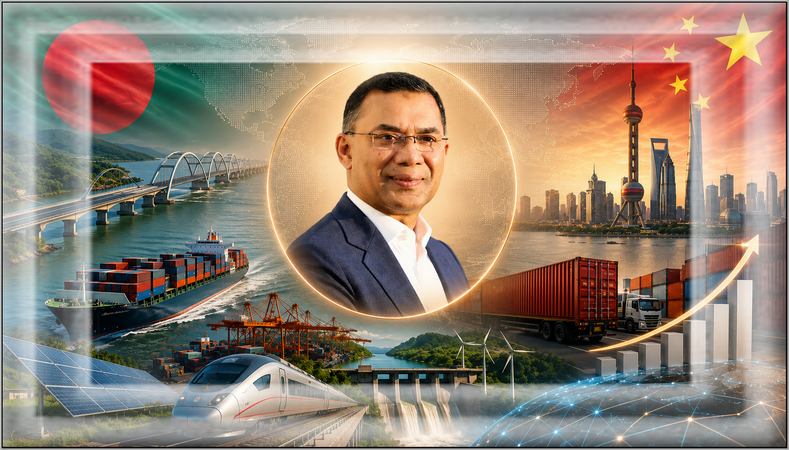
Prime Minister Tarique Rahman’s upcoming visits to Malaysia and China mark a significant diplomatic and economic initiative for Bangladesh, reflecting the government’s efforts to strengthen international partnerships, attract investment, and expand trade opportunities amid a rapidly evolving regional landscape.
The China leg of the tour is expected to be particularly consequential. According to Foreign Secretary Asad Alam Siam, Bangladesh and China are likely to sign between 15 and 17 bilateral instruments, including 13 Memorandums of Understanding (MoUs), two agreements, an action plan, and a protocol. The volume of expected agreements signals a broadening of cooperation beyond traditional infrastructure projects into areas that could include trade, connectivity, technology, and development collaboration.
A key point of interest is the possible discussion on the long-pending Teesta project. While no formal announcement has been made regarding any agreement, the issue’s inclusion in bilateral discussions highlights its continuing strategic importance. Progress on the project would not only address development needs in northern Bangladesh but also carry wider regional significance.
The visit also underscores the growing importance of Bangladesh-China relations. Meetings with Chinese Premier Li Qiang and President Xi Jinping indicate that both countries are seeking to elevate cooperation at a time when economic partnerships are becoming increasingly central to regional diplomacy.
Another important dimension of the China visit is Tarique Rahman’s participation in the World Economic Forum Annual Meeting of the New Champions 2026 in Dalian. The gathering of global business leaders, policymakers, and investors offers Bangladesh an opportunity to showcase its economic potential and attract investment in manufacturing, infrastructure, technology, and emerging industries.
The Malaysia segment of the tour carries a different but equally important focus. Discussions are expected to center on labor market cooperation, trade, and investment. Malaysia remains a major destination for Bangladeshi workers, making labor mobility and workforce opportunities key priorities. Enhanced cooperation could strengthen remittance flows while creating new employment prospects for Bangladeshi workers.
Taken together, the dual visit reflects Bangladesh’s increasingly pragmatic and economy-driven foreign policy. Rather than relying on a single partner, Dhaka is actively engaging multiple regional powers to secure investment, expand markets, and support long-term development goals.
As Tarique Rahman’s first overseas trip since taking office in February, the tour will be closely watched both at home and abroad. Its success, however, will ultimately depend not on the number of agreements signed, but on the implementation of commitments and the tangible economic benefits they deliver for Bangladesh.