Sadik Sagar, Dhaka:
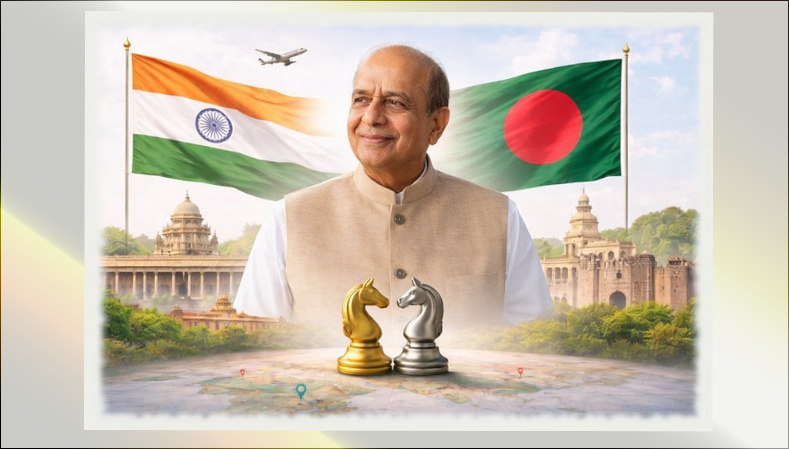
India’s decision to nominate Dinesh Trivedi as high commissioner to Dhaka marks a notable departure from convention—and a calculated diplomatic signal. Political appointments to key neighbourhood posts have been rare for New Delhi, which has traditionally relied on career diplomats. By forwarding Trivedi’s name for agrément, India appears to be prioritising political messaging and relationship management over bureaucratic continuity at a sensitive moment in bilateral ties.
The timing is significant. Relations between India and Bangladesh had sharply deteriorated during the interim administration led by Muhammad Yunus following the ouster of Sheikh Hasina. With the electoral victory of the BNP under Tarique Rahman, New Delhi is recalibrating its approach, seeking to rebuild trust with a leadership it had historically viewed with caution. The choice of a political figure rather than a career envoy suggests India believes that managing Dhaka now requires not just diplomatic skill but political signalling and backchannel flexibility.
Trivedi’s profile aligns with this need. A former railway minister in the government of Manmohan Singh and later a member of the BJP, he bridges multiple political worlds. His long association with Mamata Banerjee and the Trinamool Congress, combined with his later proximity to Narendra Modi and Amit Shah, gives him a rare cross-party credibility. Equally important is his familiarity with eastern Indian politics, particularly West Bengal, which shares deep historical, cultural and economic linkages with Bangladesh.
More broadly, the move reflects India’s recognition that its Bangladesh policy must adapt to a changed political landscape. Early outreach—from External Affairs Minister S. Jaishankar’s symbolic gestures to high-level participation in Dhaka’s political transition—indicates a willingness to engage the BNP government pragmatically. Recent discussions on energy supplies, visa facilitation and extradition requests further underscore a transactional yet constructive reset.
However, appointing a political envoy also carries risks. It may be interpreted in Dhaka as an overtly strategic move, potentially inviting scrutiny over India’s intentions. Moreover, success will depend on Trivedi’s ability to translate political access into tangible outcomes, particularly on contentious issues such as migration, border management and legal cooperation.
From an analytical standpoint, the appointment reflects a pragmatic—if cautious—shift in India’s regional diplomacy. New Delhi appears to be acknowledging that traditional state-to-state mechanisms alone may not suffice in managing increasingly political relationships in South Asia. A political envoy like Trivedi could facilitate quicker trust-building with Dhaka’s current leadership, but it also raises expectations of immediate results. If those expectations are not met, the symbolic value of the appointment could quickly erode.
Ultimately, this move is less about an individual and more about strategy. It signals India’s willingness to recalibrate, engage across political divides, and stabilise a relationship that remains vital for regional security and economic connectivity. Whether this calculated step translates into a durable reset will depend on sustained engagement, mutual concessions, and the ability of both sides to move beyond recent mistrust.