Staff Correspondent, Dhaka:
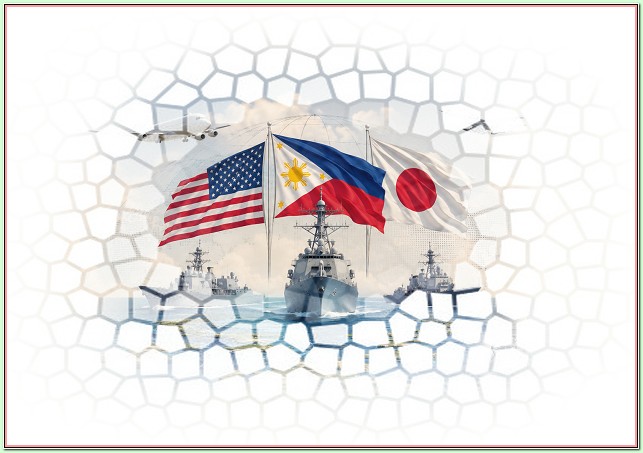
The latest joint maritime exercises involving the United States, Japan, and the Philippines have highlighted the deepening strategic alignment among the three allies as tensions with China continue to intensify in the disputed South China Sea. Conducted from July 21 to 25, the five-day exercises featured warships, coast guard vessels, surveillance aircraft, and fighter jets, underscoring a coordinated effort to enhance interoperability and reinforce deterrence in one of the world’s most contested maritime regions.
The drills come at a particularly sensitive moment. Just a day before the exercises began, Manila accused the Chinese Coast Guard of assaulting a Filipino sailor with a baton near the Second Thomas Shoal. Beijing rejected the allegation, instead claiming Philippine vessels initiated the confrontation by attacking and ramming Chinese boats. Similar accusations followed near the Scarborough Shoal, where the Philippine Coast Guard alleged that Chinese vessels used water cannons against Philippine government ships. China insisted its actions were lawful responses to what it described as illegal intrusions into its waters.
These incidents illustrate the increasingly volatile nature of the South China Sea, where competing territorial claims have transformed routine maritime patrols into potential flashpoints. While the military exercises were officially described as efforts to promote peace, stability, and security in the Indo-Pacific, they also send a clear geopolitical message: Washington and Tokyo are prepared to deepen their security commitments to Manila in response to China’s expanding maritime presence.
For the Philippines, the growing security partnership reflects a broader strategic shift toward strengthening defense cooperation with like-minded countries. The visit of newly appointed Armed Forces Chief General Antonio Nafarrete to the Philippine-controlled Thitu Island in the Spratly Islands further demonstrated Manila’s determination to reinforce its frontline positions and improve operational readiness in disputed waters.
China, meanwhile, continues to assert sovereignty over nearly the entire South China Sea based on its “nine-dash line” claim, despite the 2016 ruling by the Permanent Court of Arbitration in The Hague that invalidated those claims under international law. Beijing has consistently rejected the ruling and continues to expand its coast guard and naval activities across the region.
The implications extend well beyond the immediate parties. The South China Sea serves as one of the world’s busiest maritime trade routes, carrying trillions of dollars in global commerce annually. Any escalation could disrupt regional stability, affect international shipping, and heighten strategic competition between major powers.
As military cooperation among the United States, Japan, and the Philippines continues to expand, Beijing is likely to perceive these exercises as part of a broader containment strategy. The resulting security dilemma may further accelerate military modernization and increase the frequency of confrontations at sea. Unless supported by sustained diplomatic engagement and effective crisis management mechanisms, the region risks entering a prolonged cycle of strategic rivalry, where even minor maritime incidents could carry significant geopolitical consequences.