
Staff Correspondent, Dhaka:
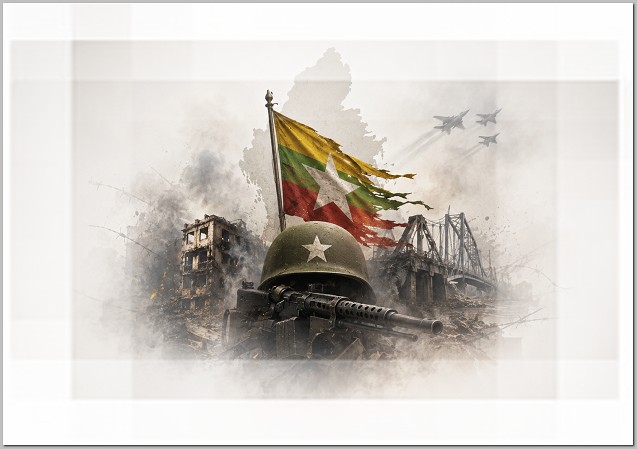
Myanmar’s military appears to be pursuing a dual-track strategy: intensifying military operations at home while expanding diplomatic engagement abroad. The latest assessment by the Armed Conflict Location & Event Data Project (ACLED) suggests that since the restructuring of the military command in March 2026, attacks on civilians have intensified significantly, raising fresh questions about the effectiveness of regional diplomacy.
According to ACLED, the appointment of Ye Win Oo as commander-in-chief following Min Aung Hlaing’s transition to the presidency has coincided with a more aggressive military campaign. The conflict monitor says the junta has increased the use of coordinated airstrikes, deploying multiple fighter jets against single targets while launching renewed offensives in strategically important border regions. The findings suggest that the leadership change has not moderated military tactics but instead reinforced efforts to consolidate territorial control through force.
The report also highlights a disturbing rise in civilian casualties. During the first half of 2026, ACLED recorded more than a dozen mass killings that claimed over 450 civilian lives, with many occurring in the conflict-ridden Anyar region. While independent verification remains difficult in many cases, the reported pattern points to a deteriorating humanitarian situation despite growing international attention.
What makes the current situation particularly significant is the contrast between Myanmar’s domestic military escalation and its renewed diplomatic outreach. Since assuming the presidency, Min Aung Hlaing has increased engagement with neighboring countries, visiting India and China while gradually re-establishing contacts with the Association of Southeast Asian Nations (ASEAN). His scheduled visit to Thailand in early August further reflects the junta’s efforts to regain regional legitimacy after years of diplomatic isolation.
This divergence presents a challenge for ASEAN and the wider international community. While dialogue remains essential for regional stability, continued engagement without measurable improvements on the ground risks weakening diplomatic pressure. Unless political negotiations are accompanied by concrete reductions in violence and meaningful humanitarian access, Myanmar’s diplomatic re-engagement is unlikely to translate into lasting peace, leaving civilians to bear the greatest cost of the conflict.