Sagar Rahman, Dhaka:
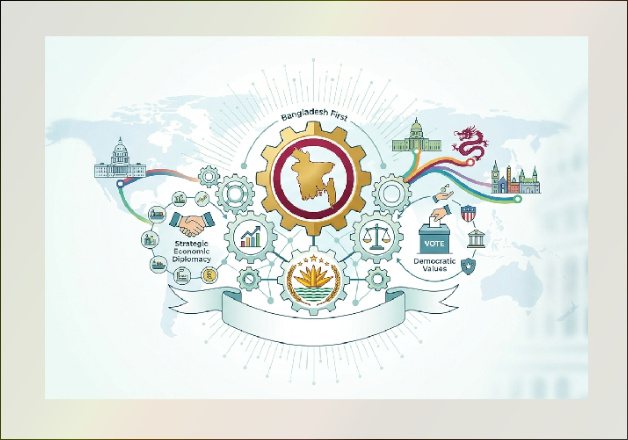
A future BNP-led government is likely to place economic diplomacy at the center of Bangladesh’s foreign policy, signaling a pragmatic shift from traditional geopolitical balancing toward trade, investment, and strategic economic positioning. Speaking at a seminar in Dhaka, Foreign Affairs Adviser to the Prime Minister Humayun Kabir outlined a “Bangladesh First” approach that emphasizes national interests, diversified partnerships, and policy flexibility amid a rapidly changing global order.
The remarks reflect an acknowledgment that Bangladesh’s next phase of development will depend less on aid-driven diplomacy and more on its ability to secure markets, attract quality investment, and strengthen regional connectivity. By identifying export expansion, energy security, and foreign investment diversification as priorities, the BNP appears to be positioning foreign policy as an extension of economic strategy rather than purely political engagement.
Kabir’s emphasis on avoiding dependence on any single country is particularly significant in the current geopolitical climate. As rivalry intensifies among major powers in the Indo-Pacific, Bangladesh has increasingly faced pressure to navigate competing strategic interests. The proposed “non-country-centric” policy suggests Dhaka would seek broader engagement with multiple partners while retaining greater strategic autonomy.
The vision of Bangladesh as an “economic bridge” connecting South Asia, Southeast Asia, and the Indo-Pacific also aligns with the country’s growing geographic and commercial relevance. Improved regional connectivity, energy cooperation, and trade integration could enhance Bangladesh’s leverage in regional diplomacy while supporting long-term economic growth.
Equally notable is the attempt to redefine Bangladesh’s global climate identity. Rather than remaining framed solely as a vulnerable nation, the BNP leadership appears eager to project Bangladesh as an active voice in climate diplomacy and climate justice negotiations. This approach could strengthen the country’s standing in international forums while helping secure fairer climate financing.
Overall, the speech indicates that a BNP foreign policy framework would likely prioritize strategic flexibility, economic competitiveness, and balanced international engagement in an increasingly multipolar world.