By Afifa Khanam
Many years ago, I visited Hudson Yards and walked along the High Line in the spring. Flowers were blooming, fresh green leaves were appearing, and everything seemed to announce the beginning of warmer days. I was mesmerized by the beauty of nature all around me.
This time, I returned in late summer.
The flowers were mostly gone. The landscape no longer had the bright, colorful feeling I remembered. Yet the High Line had a different kind of beauty.
As I walked, I found myself looking up.
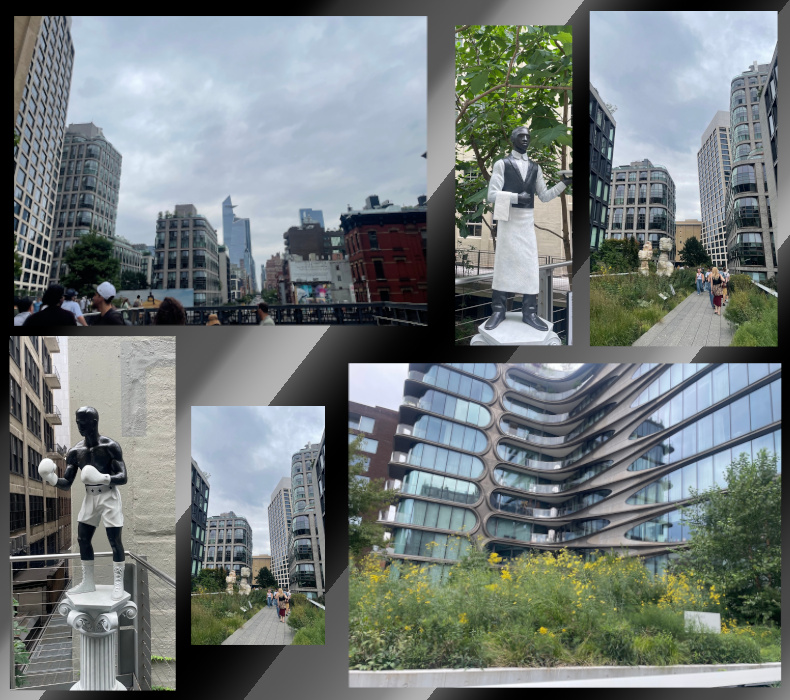
The architecture surrounding the High Line seemed almost like artwork. Glass towers reflected the sky, older brick buildings stood alongside striking modern structures, and the elevated walkway offered a perspective of New York that is difficult to experience from street level.
Same place. Different season. A completely different kind of beauty.
The High Line is one of New York City’s most distinctive public spaces. What is now a 1.45-mile elevated park was once a freight rail line running above Manhattan’s West Side. The first section of the public park opened in 2009, transforming an abandoned piece of industrial infrastructure into a place for walking, gardening, art, and community life.
Since then, the High Line has become one of New York’s major attractions. Friends of the High Line reported in 2024 that the park had grown to welcome about 7 million visitors annually, more than 20 times the number originally expected.
The visitors come from many places. New Yorkers use the High Line as a public park and walking route, while tourists from across the United States and around the world come to experience its unusual combination of nature, architecture, art, and city views. An older visitor profile found that approximately half of visitors were New Yorkers, while the other half came from outside the city. Because that study is not current, today’s visitor demographics may be different.
What makes the High Line particularly fascinating is the way nature and the city exist side by side.
The park’s landscape was designed to reflect the kinds of plants that had grown naturally along the abandoned railway. Today, gardeners carefully maintain a changing landscape of grasses, trees, perennials, and flowers. The result is a space that feels both deliberately designed and surprisingly natural.
Maintaining a public garden above one of the busiest parts of Manhattan is a major undertaking.
The High Line is owned by the City of New York but is programmed, maintained, and operated by Friends of the High Line, in partnership with the New York City Department of Parks & Recreation. The nonprofit raises nearly all of the High Line’s annual operating budget through private support, memberships, donations, and other revenue. The arrangement allows the park to receive the intensive maintenance and programming its unusual landscape requires while remaining free to the public.
The High Line is also surrounded by some of Manhattan’s most interesting destinations.
At its southern end is the Meatpacking District, with its restaurants, shops, and historic character. Nearby is the Whitney Museum of American Art, whose building overlooks the southern end of the park. The High Line also passes through the historic Chelsea Market complex, where visitors can stop for food and explore the neighborhood.
Walking north, the scenery gradually changes. The High Line leads toward Hudson Yards, where contemporary architecture dominates the skyline. Visitors can see the Vessel and The Shed, while the surrounding neighborhood offers restaurants, shops, public spaces, and dramatic views of Manhattan.
There is also a wonderful sense of history along the route. The High Line’s industrial past has not disappeared completely. Reminders of the railroad remain part of the landscape, creating an unusual contrast between old infrastructure and contemporary New York.
But for me, the most interesting part of returning to the High Line was not a particular building, garden, or attraction.
It was realizing that I was seeing the same place differently.
On my first visit, spring made me notice the flowers.
On this visit, late summer made me notice the city.
Perhaps that is one of the pleasures of returning to a familiar place. We may think we are going back to see the same thing, but we are never exactly the same person we were before. A change in season, a change in perspective, or simply the passage of time can reveal something we didn’t notice the first time.
The High Line reminded me that beauty does not disappear when one season ends. Sometimes it simply changes its form.
The first time, I looked down and saw nature.
This time, I looked up and saw New York.
Same place. Different season. A completely different kind of beauty.