Sagar Rahman, Dhaka:
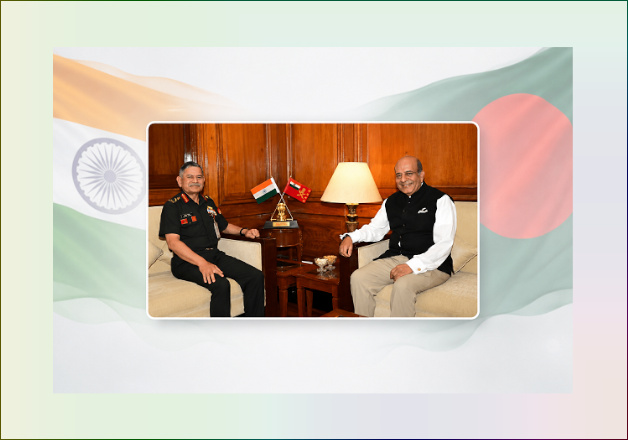
The meeting between India’s High Commissioner-designate to Bangladesh, Dinesh Trivedi, and Indian Army Chief General Upendra Dwivedi signals a deeper strategic recalibration in India-Bangladesh relations, where security cooperation, border stability, and geopolitical pragmatism are increasingly shaping bilateral engagement.
According to the Indian Army, discussions focused on strengthening defense ties, improving border security coordination, and expanding military-to-military engagement. While such consultations are standard before a diplomatic posting to Dhaka, the timing of the meeting carries broader significance amid changing political realities in Bangladesh and shifting regional dynamics in South Asia.
The interaction reflects New Delhi’s growing emphasis on ensuring stability along its eastern frontier at a time when concerns over cross-border infiltration, regional extremism, and strategic competition in the Bay of Bengal continue to evolve. Bangladesh remains a crucial neighbor in India’s “Neighborhood First” policy due to its geographic position, economic importance, and role in regional connectivity initiatives.
At the same time, Bangladesh’s response to contentious issues such as India’s Citizenship Amendment Act (CAA) and the National Register of Citizens (NRC) indicates Dhaka’s effort to maintain a cautious and institutionally balanced diplomatic posture. Home Minister Salahuddin Ahmed’s remarks describing these matters as India’s “internal issues” suggest the interim government is seeking to avoid direct political confrontation while prioritizing border management and bilateral stability.
Dhaka’s emphasis on heightened vigilance against illegal infiltration also aligns with India’s long-standing security concerns. Border management has historically been one of the most sensitive dimensions of bilateral relations, involving issues ranging from undocumented migration to smuggling and occasional border tensions. Enhanced coordination between border forces could therefore emerge as a central pillar of future engagement.
Another notable aspect is the renewed discussion surrounding the extradition request for former prime minister Sheikh Hasina. By stressing legal and diplomatic mechanisms, Bangladesh’s interim administration appears keen to frame the issue within institutional and judicial processes rather than political rhetoric. However, the matter could still test diplomatic sensitivities depending on India’s response and the broader regional political climate.
Analysts view the current phase of India-Bangladesh relations as a transition from personality-driven diplomacy toward a more interest-based framework centered on security, trade, connectivity, and regional stability. Under Prime Minister Tarique Rahman’s government, Dhaka appears to be pursuing a more pragmatic foreign policy approach that balances domestic political priorities with strategic regional partnerships.
Despite underlying complexities, both countries appear committed to preventing tensions from escalating and preserving cooperation in areas of mutual interest. The evolving relationship suggests that future India-Bangladesh engagement will increasingly be defined not by political symbolism alone, but by strategic calculations, institutional coordination, and regional security realities.