
Senior Correspondent, Dhaka:
The latest round of high-level talks between India and Nepal highlights a familiar pattern in South Asian diplomacy: contentious issues are managed quietly behind closed doors while public messaging emphasizes cooperation and partnership. Although neither side officially acknowledged discussions on the long-running boundary dispute, indications that the issue was addressed suggest that both governments are attempting to prevent territorial disagreements from overshadowing broader strategic interests.
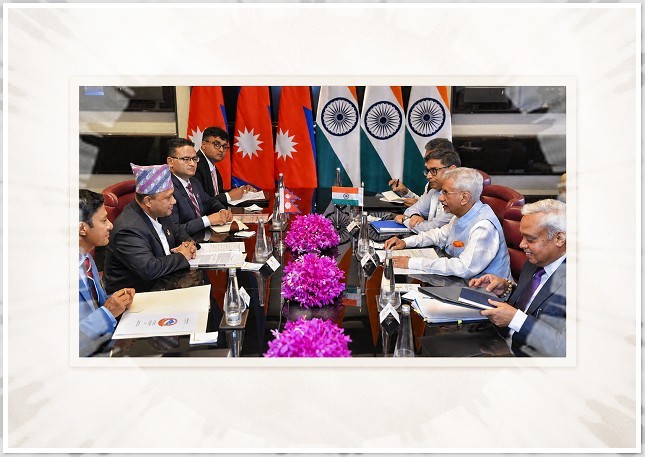
The meeting between Indian External Affairs Minister S. Jaishankar and Nepalese Foreign Minister Shisir Khanal came at a particularly sensitive time. Tensions had risen following Nepal’s objections to India’s use of the Lipulekh route for the 2026 Kailash Mansarovar Yatra and Kathmandu’s renewed claims over Lipulekh, Kalapani, and Limpiyadhura. The dispute remains rooted in differing interpretations of the 1816 Treaty of Sugauli, a colonial-era agreement whose ambiguity continues to shape modern geopolitics in the Himalayas.
What makes the current engagement noteworthy is the contrast between private discussions and public restraint. Sources indicate that both sides acknowledged progress made by a joint field team working on boundary issues and agreed to continue talks through established mechanisms. Yet official statements carefully avoided any mention of the dispute. This suggests a conscious effort to compartmentalize disagreements while preserving momentum in other areas of bilateral cooperation.
For India, maintaining stable relations with Nepal has become increasingly important amid growing geopolitical competition in South Asia. New Delhi remains sensitive to perceptions that Kathmandu may seek to internationalize the boundary issue, particularly after suggestions that Britain could play a role in resolving the dispute. India’s insistence on bilateral dialogue reflects its broader policy of keeping regional disputes outside third-party mediation frameworks.
For Nepal, the challenge lies in balancing domestic political pressures with economic realities. Territorial claims over Lipulekh, Kalapani, and Limpiyadhura enjoy broad public support and have become symbols of national sovereignty. At the same time, Nepal remains deeply interconnected with India through trade, transit, energy, employment, and cultural ties. This interdependence limits the scope for confrontation and encourages pragmatic engagement.
The outcomes announced after the talks reinforce this pragmatism. Cross-border digital payment connectivity, infrastructure reconstruction projects, cooperation in artificial intelligence, and enhanced legal assistance demonstrate that both governments continue to invest in expanding functional cooperation despite political differences.
The broader message emerging from the visit is that India and Nepal are pursuing a dual-track approach: managing border disputes through quiet diplomacy while advancing economic and developmental partnerships in public. Whether this strategy can eventually create the political space needed for a lasting settlement remains uncertain, but it has succeeded in preventing a sensitive territorial disagreement from derailing one of South Asia’s most important bilateral relationships.