Staff Correspondent, Dhaka:
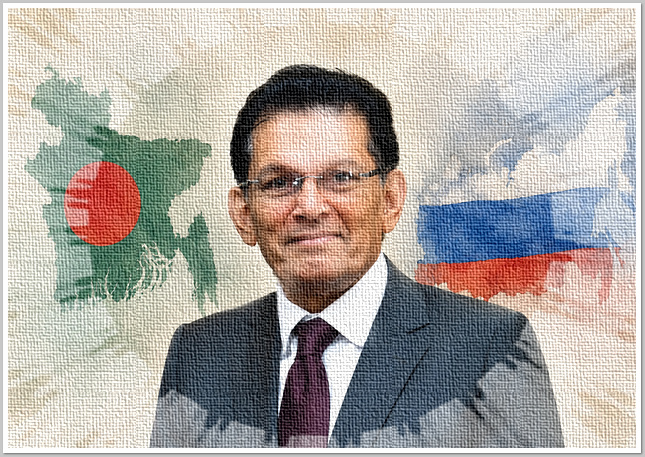
Foreign Minister Dr. Khalilur Rahman’s three-day official visit to Russia comes at a diplomatically significant moment for Bangladesh. It’s reflecting Dhaka’s effort to deepen strategic partnerships while navigating an increasingly complex global landscape. The minister departed for Russia on June 7 morning and is scheduled to return home on 9 June.
The visit, which marks his first overseas engagement since being elected president of the United Nations General Assembly (UNGA), carries implications that extend beyond routine bilateral diplomacy.
Bangladesh and Russia have maintained a longstanding relationship rooted in political support, defense cooperation, energy collaboration, and economic engagement. In recent years, the partnership has been most visibly represented by Russia’s involvement in the Rooppur Nuclear Power Plant project, one of Bangladesh’s largest infrastructure undertakings. Against this backdrop, the foreign minister’s visit signals Dhaka’s intention to sustain momentum in a relationship that remains strategically important despite shifting global alignments.
The timing is particularly noteworthy. Bangladesh is currently pursuing a foreign policy that seeks to diversify partnerships while avoiding excessive dependence on any single global power. In this context, strengthening engagement with Moscow complements Dhaka’s parallel efforts to deepen ties with China, Japan, the United States, the European Union, and regional partners. The visit therefore reflects Bangladesh’s continued commitment to a multi-vector foreign policy designed to maximize economic and strategic opportunities.
The scheduled bilateral talks between Dr. Rahman and Russian Foreign Minister Sergei Lavrov are expected to address both bilateral and multilateral issues. Beyond trade and investment, discussions may touch on energy security, food supply chains, international financial pressures, and evolving geopolitical dynamics. Russia remains an influential actor in global governance debates, making Moscow an important diplomatic interlocutor for Bangladesh at a time of heightened international polarization.
Dr Rahman’s newly acquired role as president of the UN General Assembly adds another layer of significance to the visit. Diplomatic observers believe discussions could include cooperation on key multilateral issues, including UN reform, sustainable development financing, peacebuilding, and the concerns of developing countries. His engagement with Russian leadership offers an opportunity to strengthen dialogue with a permanent member of the UN Security Council ahead of a demanding UNGA session.
The presence of the prime minister’s foreign affairs adviser, Humayun Kabir, alongside the foreign minister further underscores the importance attached to the visit. It suggests a coordinated effort to align Bangladesh’s bilateral priorities with its broader international agenda.
Ultimately, the Moscow visit illustrates Bangladesh’s determination to maintain constructive relations with all major powers. As global rivalries intensify, Dhaka appears intent on preserving strategic flexibility—an approach that has increasingly become the defining feature of its contemporary diplomacy.