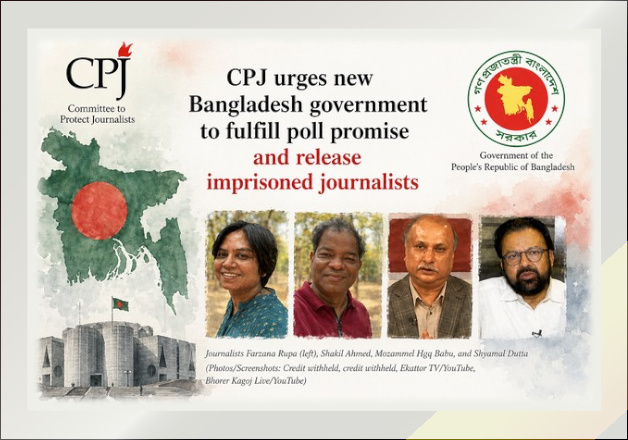
AIP Wire Special, New York — The Committee to Protect Journalists (CPJ) has urged the government of Bangladesh to withdraw what it describes as politically motivated cases against four detained journalists, calling for their immediate release and improved access to medical care.
In a formal letter dated April 27, 2026, addressed to Law Minister Md. Asaduzzaman, the New York–based press freedom organization appealed to authorities to drop charges against Farzana Rupa, Shakil Ahmed, Mozammel Haq Babu, and Shyamal Dutta, who have been held for more than 18 months on murder allegations.
CPJ stated that no credible evidence has been presented against the journalists and that authorities have failed to file a charge sheet in nearly 600 days, raising concerns over due process and compliance with legal standards. The organization noted that the cases appear to be linked to the journalists’ reporting and perceived political affiliations under the previous administration.
The letter also pointed to early signals from the current government that had raised expectations of reform. CPJ referenced commitments made in the Bangladesh Nationalist Party’s manifesto, including pledges to withdraw politically motivated cases against journalists and strengthen protections for media workers.
Beyond legal concerns, CPJ highlighted serious humanitarian issues surrounding the detainees. According to the organization, Shyamal Dutta suffered a stroke shortly after his detention and has pre-existing cardiac conditions and severe sleep apnea that remain unassessed in custody. Mozammel Haq Babu, who previously underwent major surgery for prostate cancer, has reportedly not received necessary follow-up medical care. Farzana Rupa was held for two weeks in November 2024 in a “condemnation cell” typically reserved for death-row inmates.
CPJ emphasized that these conditions raise urgent human rights concerns and urged the government to ensure immediate medical attention for the detained journalists while their cases remain unresolved.
The organization also cited Bangladesh’s constitutional protections for freedom of expression under Article 39, as well as its obligations under the International Covenant on Civil and Political Rights, to which the country is a signatory.
CPJ said that resolving these cases would send a strong signal internationally about the government’s commitment to democratic reforms and press freedom. The group also expressed interest in engaging directly with Bangladeshi authorities on broader media freedom issues.
The appeal comes amid continued international scrutiny of press freedom conditions in Bangladesh, where rights groups have repeatedly raised concerns over the use of legal measures against journalists.