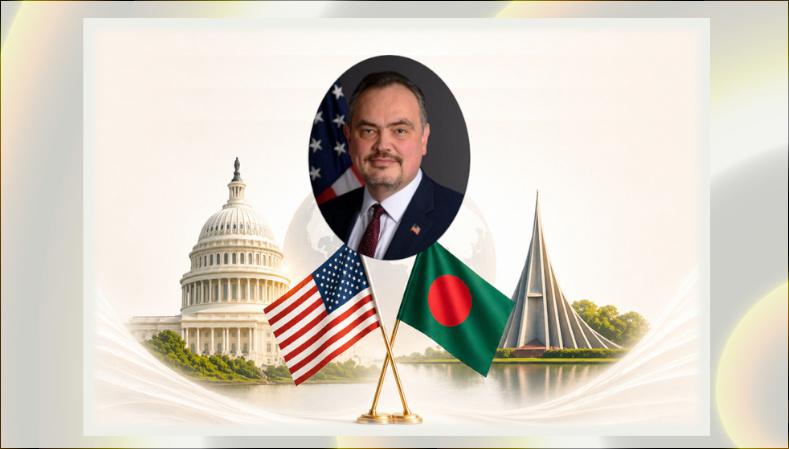
The completion of US Ambassador Brent T. Christensen’s first 100 days in Dhaka offers an early but revealing snapshot of Washington’s evolving approach toward Bangladesh—one that blends strategic signaling, economic pragmatism, and calibrated public diplomacy.
Marking the completion of 100 days in Dhaka, Ambassador Christensen released a video message released on April 22.
Christensen’s tenure began at a politically sensitive juncture, arriving just ahead of Bangladesh’s February elections. The United States’ swift recognition of the results set a pragmatic tone, indicating a willingness to stabilise ties and move forward after periods of strain over governance and electoral concerns. This early positioning appears to have created space for a more functional, interest-driven engagement.
A central pillar of the ambassador’s messaging is economic cooperation, underscored by what he termed a “historic” trade agreement. While details remain limited in the public domain, the framing suggests a US intent to rebalance trade dynamics while expanding opportunities for American businesses in Bangladesh’s growing market. This aligns with Washington’s broader Indo-Pacific economic strategy, where supply chain diversification and new market linkages are gaining urgency.
At the same time, Christensen’s outreach reflects a deliberate effort to broaden engagement beyond elite corridors. His participation in cultural events like Pahela Baishakh, interactions with local communities, and emphasis on people-to-people ties signal a soft-power approach designed to rebuild public goodwill. Such gestures, while symbolic, play a role in countering perceptions of a purely transactional US policy.
Security cooperation forms another key dimension. The ambassador’s remarks on tackling illegal migration and visa fraud point to continued US concerns over mobility governance, while references to a “free and open Indo-Pacific” indicate Bangladesh’s growing relevance in regional strategic calculations. Dhaka’s geographic position and its balancing diplomacy make it an important partner in this framework, even as it seeks to avoid overt alignment with major power blocs.
On humanitarian and development fronts, Washington’s sustained support for Rohingya refugees and new health initiatives reinforce continuity in US assistance policy. By highlighting leadership in refugee aid and disease control, the US positions itself as a long-term development partner, not merely a strategic actor.
However, the broader trajectory will depend on how these early signals translate into tangible outcomes. Trade agreements must deliver measurable gains, and strategic cooperation must align with Bangladesh’s principle of non-alignment. Moreover, domestic political dynamics in both countries could influence the pace and depth of engagement.
Christensen’s first 100 days, therefore, should be read less as a culmination and more as a foundation. They suggest a structured attempt by Washington to recalibrate relations—anchoring them in economic interests, strategic alignment, and renewed public diplomacy—while leaving open questions about sustainability and long-term impact.