Anwar Shahadat, New York.
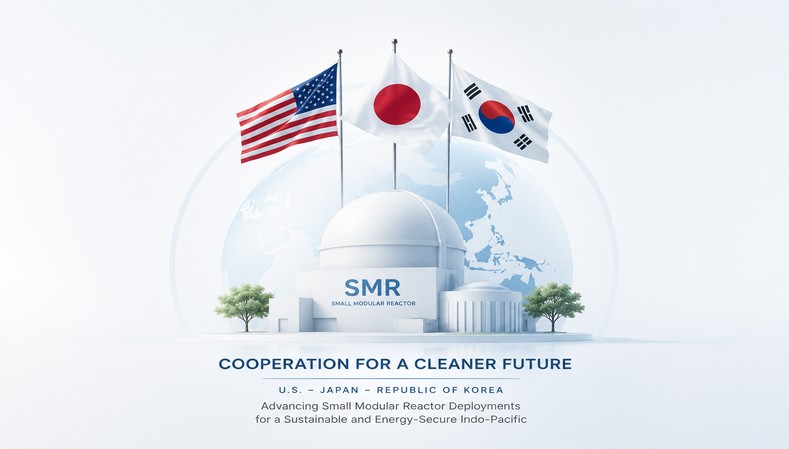
The United States, Japan, and the Republic of Korea have signed a trilateral Memorandum of Cooperation (MOC) aimed at accelerating the deployment of Small Modular Reactors (SMRs) in third countries. This marks a significant step in the three allies’ broader strategy to strengthen energy security and economic cooperation across the Indo-Pacific. The agreement was signed on the sidelines of the NATO Summit in Türkiye. Action establishes a framework for coordinating their respective nuclear industries in developing SMR projects abroad while maintaining high standards of nuclear safety, security, and nonproliferation.
Although the memorandum does not identify specific recipient countries, its initial focus on the Indo-Pacific provides a strong indication of where future cooperation may be directed. The agreement calls for identifying interested host countries, encouraging industrial partnerships among American, Japanese, and South Korean companies, and mobilizing financing to support future projects. Rather than promoting a single reactor design, the initiative seeks to combine the technological expertise, manufacturing capabilities, and financial resources of all three partners to make SMRs a more competitive option for emerging economies.
Several countries across Asia could emerge as potential candidates over the coming decade. Nations such as Indonesia and the Philippines have expressed interest in expanding nuclear energy to meet growing electricity demand, while Vietnam has periodically revisited nuclear power as part of its long-term energy planning. Thailand and Malaysia continue to study advanced nuclear technologies, although neither has formally committed to deployment. In South Asia, India is actively pursuing its own indigenous SMR program and is therefore more likely to cooperate selectively on technology or supply chains rather than import complete reactor systems. Bangladesh, which is already developing conventional nuclear power with Russian assistance, could consider SMRs in the longer term if demand for decentralized electricity generation increases. Cambodia, Laos, and Myanmar are less likely near-term candidates given their infrastructure, financing, and regulatory challenges, though they could become future markets if conditions evolve. These possibilities remain analytical assessments rather than announced plans under the memorandum.
Beyond energy, the initiative reflects a broader geopolitical strategy. Reliable electricity is becoming increasingly important as countries expand manufacturing, electrify transportation, develop artificial intelligence infrastructure, and seek cleaner sources of power. SMRs are promoted as offering lower upfront costs, greater flexibility, and the ability to serve remote industrial sites or growing urban centers where constructing large conventional nuclear plants may be more difficult.
The agreement also illustrates how the United States and its allies are broadening their Indo-Pacific engagement beyond traditional security cooperation. Alongside defense partnerships, Washington, Tokyo, and Seoul are increasingly emphasizing infrastructure, advanced technology, resilient supply chains, and clean energy as instruments of long-term regional engagement. By coordinating SMR exports, the three countries hope to provide partner nations with additional options for meeting future energy needs while strengthening commercial ties among like-minded economies.
The memorandum should not be viewed solely through the lens of strategic competition. Many Indo-Pacific countries are expected to require substantial new electricity generation over the next two decades to support economic growth and climate objectives. For the United States, Japan, and South Korea, It jointly promoting SMRs also creates opportunities for their domestic nuclear industries, encourages private investment, strengthens supply chains, and enhances international competitiveness in an emerging sector where several countries are seeking to establish leadership.
Whether these ambitions translate into operational projects will depend on financing, host-country regulations, public acceptance, and commercial viability. Nevertheless, the agreement signals that civil nuclear cooperation is becoming an increasingly important element of Indo-Pacific policy, with energy security, economic development, and strategic partnerships expected to remain closely interconnected in the years ahead.