Special Correspondent, Dhaka:
Biman Bangladesh Airlines is moving towards agreements for 21 additional Boeing and Airbus aircraft, a fleet expansion that could significantly reshape the national flag carrier but also put greater focus on the commercial rationale, financing, and management of such a large order.
Sources familiar with the process said Biman may sign an agreement for 11 Boeing aircraft during the UN General Assembly, followed by a deal for 10 Airbus aircraft in October. Details of the Boeing package, including variants, price, financing, and delivery schedules, have yet to be disclosed.
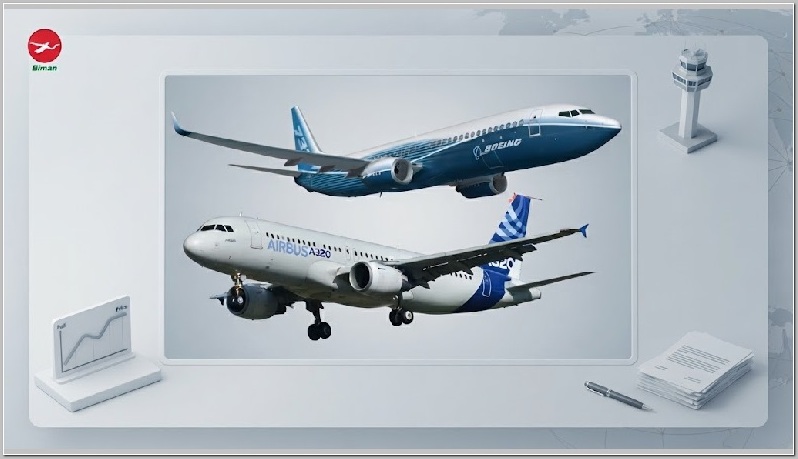
The proposed Airbus package comprises four A350-900s and six A321neos. It would come on top of Biman’s $3.7 billion agreement signed in April for 14 Boeing aircraft—eight 787-10s, two 787-9s, and four 737 MAX 8s. Deliveries under that agreement are scheduled between November 2031 and October 2035.
Taken together, the proposed purchases would leave Biman with 35 aircraft in its order pipeline, compared with its current operating fleet of 19. The scale of the expansion reflects the government’s stated ambition to increase connectivity and open new routes, but it also creates a broader question: whether Biman can generate sufficient revenue and utilization from the additional capacity to justify the investment.
State Minister for Foreign Affairs Humaiun Kobir said on September 12 that Bangladesh needed to expand its aircraft fleet to support new routes and networks, adding that aircraft procurement was a business matter for Bangladesh.
The procurement process, however, is also attracting attention over commercial terms. EU Ambassador Michael Miller recently urged the government to maintain a level playing field and make aircraft decisions on the basis of commercial merit.
Civil Aviation and Tourism Minister M Rashiduzzaman Millat said on September 15 that Biman was facing an aircraft shortage and that procurement would be conducted transparently based on recommendations from the High-Level Negotiation Committee.
The Airbus proposal has already moved beyond its earlier August 31 target. Sources now expect signing in October. They also said Airbus had proposed financing covering 85 percent of the purchase cost through arrangements involving the UK, Germany, and France. The package reportedly includes MRO services, pilot and cabin-crew training, fleet planning, and cabin design.
This could make the Airbus proposal broader than a straightforward aircraft purchase. At the same time, the financing terms, interest rates, and long-term operating costs will be important to assessing its commercial impact.
The planned expansion also comes as Biman seeks improvements in supporting aviation infrastructure. The government is pursuing the removal of the EU’s High Risk Cargo & Mail status and preparing to introduce Explosive Detection Systems at airports.
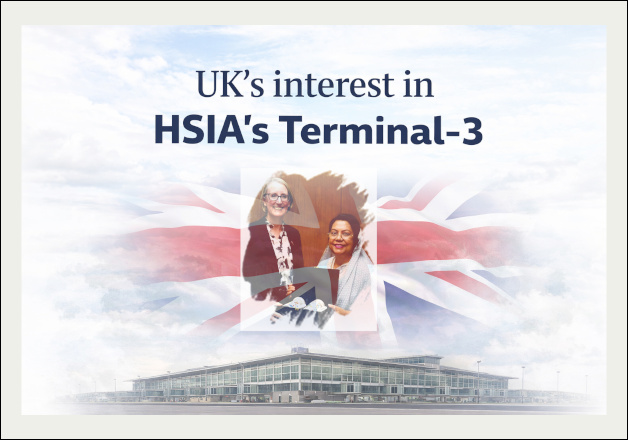
Meanwhile, UK-based Menzies Aviation is seeking approval to handle cargo at the third terminal, potentially creating around 1,000 local jobs. The Japanese consortium operating the terminal will have the prerogative to select a second ground-handling operator alongside Biman.
For Biman, therefore, the emerging fleet strategy is not simply about adding aircraft. Its success will depend on whether new capacity is matched by profitable routes, efficient fleet utilization, competitive procurement terms, financing discipline, and adequate ground-handling and maintenance capacity.