Staff correspondent, Dhaka:
The United Kingdom has reaffirmed its commitment to supporting Bangladesh’s democratic development, signaling continued international backing as the country prepares for local government elections and pursues broader institutional reforms under the current administration.
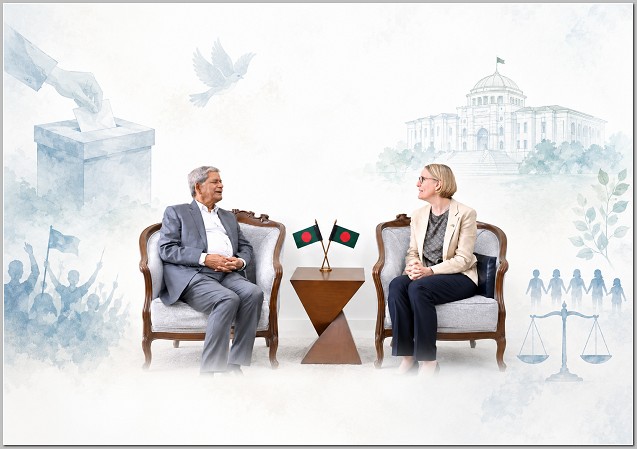
The assurance came during a meeting between British High Commissioner Sarah Cooke and Local Government, Rural Development and Cooperatives Minister Mirza Fakhrul Islam Alamgir at the Secretariat in Dhaka. The discussion covered a wide range of issues, including local government elections, education, investment, climate change, migration, women’s empowerment and governance, reflecting the expanding scope of Bangladesh-UK cooperation.
One of the most significant takeaways from the meeting was the government’s plan to begin local government elections with Union Parishad polls in phases by next December. The initiative is expected to be an important step in restoring grassroots democratic governance and strengthening local institutions following the country’s recent political transition.
The UK’s pledge to provide the necessary support for democratic institutions carries diplomatic significance. As one of Bangladesh’s longstanding development partners, Britain’s continued engagement may help reinforce international confidence in the country’s reform agenda, particularly in areas related to electoral governance, institutional capacity and public administration.
Minister Fakhrul emphasized that the government remains committed to multi-party democracy and democratic values while expressing optimism that the country’s democratic foundations would become stronger under Prime Minister Tarique Rahman’s leadership. He also encouraged greater British investment, linking political stability with economic growth and foreign direct investment.
High Commissioner Cooke acknowledged Bangladesh’s recent progress in democracy, women’s empowerment and education, while expressing interest in expanding educational opportunities for Bangladeshi students in the United Kingdom. Her remarks suggest that bilateral relations are evolving beyond traditional development cooperation toward deeper partnerships in education, governance and economic collaboration.
Separately, the minister met a delegation from the United Nations Office for Project Services (UNOPS), where discussions focused on infrastructure development, waste management, drainage systems and project implementation. The meeting highlighted that alongside democratic reforms, the government is also prioritizing improvements in local governance and public service delivery.
Taken together, the two meetings underscore Bangladesh’s effort to combine democratic consolidation with institutional modernization. Sustaining this momentum through credible elections, effective local governance and stronger international partnerships will be crucial in translating diplomatic support into lasting democratic and economic progress.