Dhaka Emerges as South Asia’s Diplomatic Hub Amid Surge of High-Level Global Visits
Sadik Sagar, Dhaka:
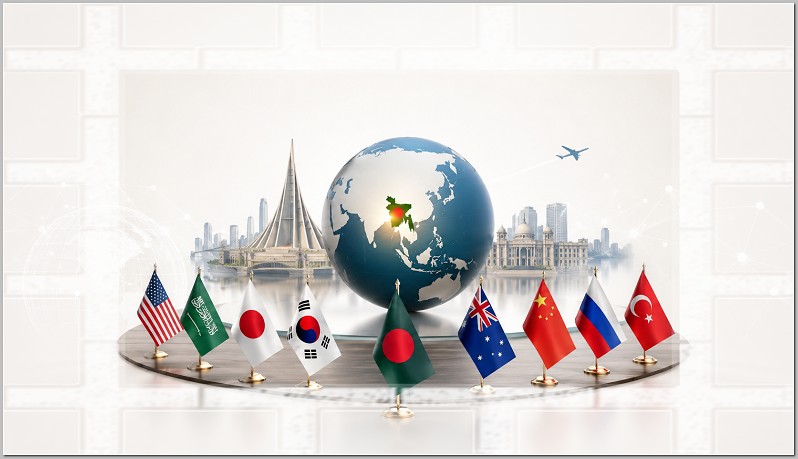
Over the past few days, Dhaka has emerged as one of South Asia’s busiest diplomatic hubs, hosting a series of high-level foreign delegations from the United States, Saudi Arabia, Japan, South Korea, Australia, China, Russia, and Türkiye. While each visit focused on different sectors, together they reveal a broader trend: Bangladesh is increasingly being viewed as a strategic economic, geopolitical, and investment partner.
Leading the engagements was Admiral Stephen T. Koehler, Commander of the United States Pacific Fleet, who praised Bangladesh’s contribution to United Nations peacekeeping missions, particularly in Africa, during his meeting with Prime Minister Tarique Rahman. His visit coincided with that of Sergio Gor, US Special Envoy for South and Central Asia, whose discussions with the Prime Minister focused on bilateral relations, trade, investment and regional cooperation. Together, the two visits reflected Washington’s expanding engagement with Bangladesh in both strategic and economic spheres.
Economic diplomacy dominated the remaining visits. Eng. Waleed Elkhereji, Saudi Arabia’s Vice Minister for Foreign Affairs, discussed expanding Saudi investment, particularly in Bangladesh’s renewable energy sector, as Prime Minister Tarique Rahman invited Saudi investors to participate in solar power projects.
From Japan, Uno Yoshimasa, Special Advisor to the Prime Minister of Japan, explored greater cooperation in skilled manpower recruitment, human resource development and Japanese investment. The discussions highlighted Bangladesh’s ambition to strengthen its workforce while attracting long-term industrial investment.
Trade relations also received significant attention during the visit of Yeo Han-Koo, South Korea’s Minister for Trade, who discussed the proposed Comprehensive Economic Partnership Agreement (CEPA). The agreement is expected to deepen bilateral trade while encouraging greater South Korean investment in electronics, telecommunications, automobiles, semiconductors and shipbuilding.
Migration and education formed another important pillar of the diplomatic engagements. Hon. Julian Hill MP, Australia’s Assistant Minister for Citizenship, Customs and Multicultural Affairs and Assistant Minister for International Education, met Foreign Minister Dr. Khalilur Rahman to discuss safe migration pathways and cooperation against irregular migration and human trafficking. Meanwhile, Chen Zhimin, Vice President of China’s Fudan University, led a delegation that met Bangladesh’s Education Minister to strengthen academic collaboration, student and faculty exchanges, and cooperation in artificial intelligence.
Russia also reinforced its economic partnership with Bangladesh as Vyacheslav Sentyurin, Chargé d’Affaires of the Russian Federation in Bangladesh, led a delegation offering lower-priced urea fertilizer and broader food commodity cooperation to strengthen Bangladesh’s food security and bilateral trade.
The private sector added further momentum to Bangladesh’s investment outlook when senior executives of Türkiye’s Sanko Group announced a US$300 million investment in a modern integrated textile manufacturing facility in the Mirsarai industrial zone, one of the latest major foreign direct investments in the country’s textile industry.
Taken together, these engagements demonstrate that Bangladesh is attracting attention from major global and regional powers across multiple sectors rather than relying on a single strategic partnership. Dhaka’s balanced foreign policy, combined with its expanding market, young workforce and strategic location, is positioning the country as an increasingly important destination for diplomacy, investment and regional cooperation.
If the commitments discussed during these visits are translated into concrete agreements and sustained implementation, Bangladesh could further consolidate its position as one of South Asia’s emerging economic and strategic hubs.