Sagar Rahman, Dhaka:
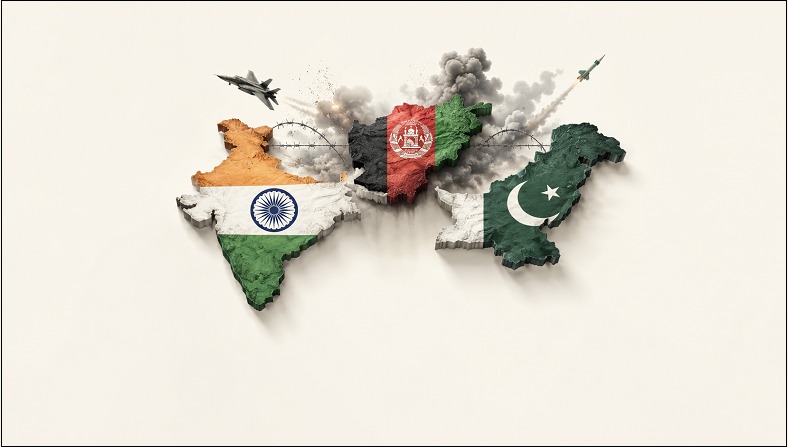
Pakistan is confronting simultaneous security and diplomatic pressures as renewed military operations along the Afghan border coincide with another sharp exchange of accusations with India following a deadly militant attack in Karachi. Together, the developments illustrate Islamabad’s increasingly complex regional security environment, where domestic militancy, cross-border tensions and geopolitical rivalries are becoming more closely intertwined.
Pakistan launched airstrikes and ground operations in eastern Afghanistan on Monday, saying it targeted Jamaat-ul-Ahrar, a splinter faction of the Tehreek-i-Taliban Pakistan (TTP), which Islamabad blames for Saturday’s attack on a Pakistan Rangers camp in Karachi. According to Pakistani authorities, the operations killed 25 militants and destroyed several militant positions in Paktia, Paktika and Kunar provinces.
The Taliban administration, however, presented a sharply different account, claiming the strikes killed 36 civilians and injured 163 others. Afghan officials also alleged that one of the targeted locations was struck a second time while residents were conducting rescue operations. Kabul has consistently rejected Pakistan’s longstanding allegation that anti-Pakistan militant groups operate from Afghan territory with official tolerance.
The latest strikes represent another deterioration in relations between the two neighbors, despite a ceasefire reached in March following weeks of intense fighting earlier this year. Since the Taliban returned to power in 2021, Pakistan has repeatedly argued that militant attacks inside its territory have increased due to cross-border sanctuaries, while the Taliban government insists Pakistan’s military operations violate Afghan sovereignty and disproportionately affect civilians.
The security crisis has also spilled into Pakistan’s diplomatic relations with India. Following the Karachi attack, Pakistani officials accused India of supporting the attackers, an allegation New Delhi swiftly rejected as “baseless.” India urged Pakistan instead to focus on addressing militant networks operating within its own borders.
The exchange reflects a recurring pattern in India-Pakistan relations, where major security incidents are often followed by competing political narratives before independent investigations establish responsibility. At present, no publicly verified evidence has been presented linking India to the Karachi attack.
Beyond the diplomatic rhetoric, the developments expose Pakistan’s broader internal security challenge. The country is simultaneously confronting violence from the TTP along its western frontier, separatist insurgencies led by the Baloch Liberation Army (BLA) in Balochistan, and militant attacks targeting security forces in urban centers. These overlapping threats have compelled Islamabad to expand military operations while balancing increasingly strained relations with neighboring states.
For regional stability, the dual tensions carry wider implications. Continued military exchanges with Afghanistan risk undermining border security and humanitarian conditions, while renewed hostility with India further limits opportunities for diplomatic engagement between South Asia’s two nuclear-armed neighbors.
Analysts argue that although military operations may disrupt militant networks in the short term, lasting stability will depend on sustained border cooperation with Afghanistan, credible counterterrorism coordination, and improved political dialogue across the region. Without these elements, Pakistan is likely to remain caught between persistent internal insurgencies and recurring diplomatic confrontations that reinforce regional instability.