Senior Correspondent, Dhaka:
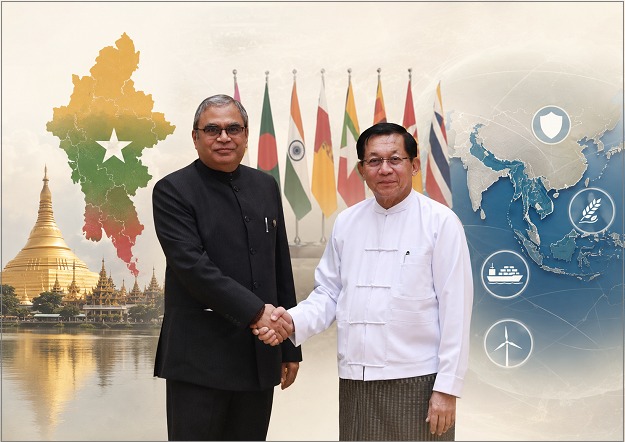
BIMSTEC Secretary General Indra Mani Pandey’s recent visit to Naypyidaw has highlighted the regional bloc’s effort to maintain functional cooperation with Myanmar while navigating the political sensitivities surrounding the country’s military-led government.
Pandey visited Myanmar from June 22 to 24, meeting President Min Aung Hlaing and senior officials ahead of the 5th BIMSTEC National Security Advisers’ Meeting, scheduled for July 16 in New Delhi. According to the BIMSTEC Secretariat and Myanmar’s foreign ministry, discussions focused on counterterrorism, transnational crime, maritime security, food security, climate resilience and energy cooperation—areas that have become increasingly central to BIMSTEC’s regional agenda.
The visit comes at a politically sensitive time. Min Aung Hlaing, who seized power in the February 2021 military coup, assumed the presidency following the 2026 elections, a process that has been widely questioned by democracy advocates and international rights organizations. Critics argue that the polls lacked credibility because voting could not take place across significant areas controlled by resistance groups.
Despite these concerns, BIMSTEC has continued engaging Myanmar as one of its seven founding members. Established in 1997 and headquartered in Dhaka, the Bay of Bengal Initiative for Multi-Sectoral Technical and Economic Cooperation has increasingly prioritized practical collaboration in security, connectivity and economic development among Bangladesh, Bhutan, India, Myanmar, Nepal, Sri Lanka and Thailand.
During the meeting, Min Aung Hlaing reaffirmed Myanmar’s commitment to regional cooperation and described BIMSTEC as a “non-political” platform. The remarks underscore Naypyidaw’s interest in maintaining its role in regional institutions despite broader international isolation.
For BIMSTEC, the engagement reflects practical considerations. Myanmar leads the bloc’s agriculture and food security sector while also occupying a strategic geographic position linking South and Southeast Asia. Security cooperation with Myanmar remains particularly important for regional efforts to address cross-border crime, terrorism, maritime challenges and illegal trafficking in the Bay of Bengal.
India, which plays a leading role in BIMSTEC’s security architecture, also has strategic interests in maintaining dialogue with Myanmar on border security and regional connectivity. These priorities have encouraged continued institutional engagement despite political differences.
At the same time, the visit illustrates the diplomatic balancing act facing regional organizations. While continued engagement supports cooperation on shared security challenges, it also raises concerns among democracy advocates that high-level contacts could be interpreted as lending political legitimacy to Myanmar’s military-led administration.
As BIMSTEC expands its regional role, the organization is likely to continue balancing strategic cooperation with the political complexities surrounding one of its member states, making Myanmar an enduring test of the bloc’s pragmatic, consensus-based approach.