Sadik Sagar, Dhaka:
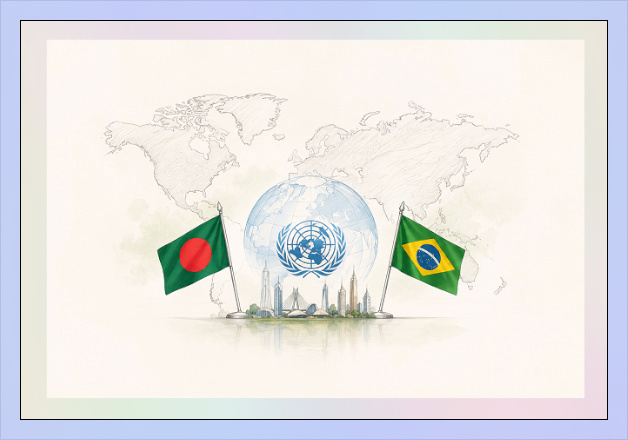
Brazil’s formal endorsement of Bangladesh’s bid for the presidency of the 81st session of the United Nations General Assembly (UNGA) and its assurance of support for Dhaka’s BRICS aspirations mark a significant diplomatic milestone for Bangladesh at a time of shifting global power dynamics. The developments emerging from the high-level meeting between Prime Minister’s Foreign Affairs Adviser Humayun Kabir and Brazilian President Luiz Inácio Lula da Silva’s chief adviser Celso Amorim indicate that Bangladesh is increasingly being viewed as an influential actor within the Global South.
The support from Brazil carries strategic importance on multiple fronts. First, backing Bangladesh in the upcoming UNGA presidential election against Cyprus strengthens Dhaka’s international credibility and reflects confidence in its growing role in multilateral diplomacy. Bangladesh’s campaign slogan — “Restoring Trust, Managing Transformation: A United Nations That Delivers for All” — aligns closely with ongoing calls from developing nations for reform of global governance institutions that are often perceived as dominated by major powers.
Second, Brazil’s willingness to advocate for Bangladesh’s inclusion in BRICS signals a potentially transformative shift in Dhaka’s foreign policy outreach. Membership in BRICS or closer engagement with the bloc would provide Bangladesh greater access to alternative financial mechanisms, investment opportunities and strategic partnerships beyond traditional Western-led institutions. For Bangladesh, which is preparing for post-LDC graduation challenges, deeper engagement with emerging economies could help diversify trade, investment and development financing sources.
The proposed “Tête-à-Tête Strategic Forum” also demonstrates an effort by both countries to institutionalize strategic dialogue. Such a mechanism could elevate Bangladesh-Brazil relations from conventional trade cooperation to a broader geopolitical partnership encompassing technology, agriculture, energy, healthcare and innovation. The announcement that 16 additional agreements are ready for signing further underlines the expanding scope of bilateral cooperation.
Economically, the relationship remains underutilized despite bilateral trade nearing US$4 billion. Bangladesh’s dependence on Brazilian cotton, soybeans and industrial raw materials complements Brazil’s potential market for Bangladeshi garments, pharmaceuticals and jute products. However, the absence of direct shipping connectivity and limited investment engagement continue to constrain trade expansion.
The discussions also reveal Bangladesh’s attempt to balance its foreign policy amid evolving geopolitical competition. While reaffirming ties with China and Russia, Dhaka simultaneously seeks stronger engagement with influential middle powers like Brazil. This reflects Bangladesh’s broader strategy of maintaining strategic autonomy while maximizing economic and diplomatic opportunities.
Ultimately, Brazil’s endorsement represents more than symbolic diplomatic support. It signals Bangladesh’s emergence as a credible Global South stakeholder capable of playing a larger role in shaping debates on multilateralism, economic cooperation and the evolving multipolar international order.