Staff Correspondent, Dhaka:
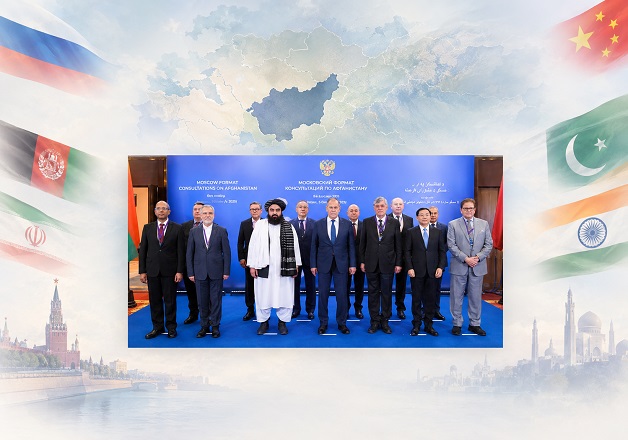
Russia’s hosting of annual Afghanistan consultations in Moscow has highlighted its growing diplomatic engagement with the Taliban while exposing the widening security divide between Kabul and Islamabad.
The meeting brought together Taliban officials and representatives from China, India, Iran, Pakistan, and Central Asian states, giving Moscow a platform to position itself as an influential regional actor. Russia, which became the first country to formally recognize the Taliban government in July 2025 after removing the group from its list of outlawed organizations, reiterated its support for Kabul while offering to help mediate its escalating dispute with Pakistan.
Foreign Minister Sergey Lavrov praised the Taliban’s counterterrorism and anti-narcotics efforts and strongly rejected any prospect of renewed NATO military infrastructure in Afghanistan or neighboring states. His remarks reflected Moscow’s broader strategic objective of limiting Western security influence in a region it considers strategically important.
However, the Afghanistan-Pakistan confrontation presented the most immediate challenge at the talks. Pakistan accused the Taliban government of enabling the Tehrik-e-Taliban Pakistan (TTP) and other militant groups responsible for attacks inside Pakistan. Islamabad also defended its recent cross-border strikes as defensive and intelligence-based.
The Taliban rejected the allegations and accused Pakistan of killing Afghan civilians through airstrikes. The competing claims underscore the absence of a durable mechanism for resolving the security dispute, despite international mediation efforts.
For Russia, the tensions create both an opportunity and a risk. Moscow can strengthen its diplomatic relevance by offering itself as a mediator, but deeper involvement could also expose Russia to a complex conflict involving competing regional interests.
The talks therefore demonstrated the changing diplomatic landscape surrounding Afghanistan. While the Taliban is gradually developing relations with regional powers, its international isolation remains significant, particularly over restrictions on women. Moscow’s engagement may help reduce that isolation, but it is unlikely by itself to resolve Afghanistan’s security and governance challenges.