
Senior Correspondent, Dhaka:
The United States’ decision to facilitate Russian diesel supplies amid a deepening energy crisis highlights the growing vulnerability of global fuel markets and the tension between geopolitical sanctions and domestic economic priorities. While President Donald Trump hopes the arrangement will ease prices ahead of November’s midterm elections, its impact may remain limited as supply disruptions extend across major energy-producing and shipping regions.
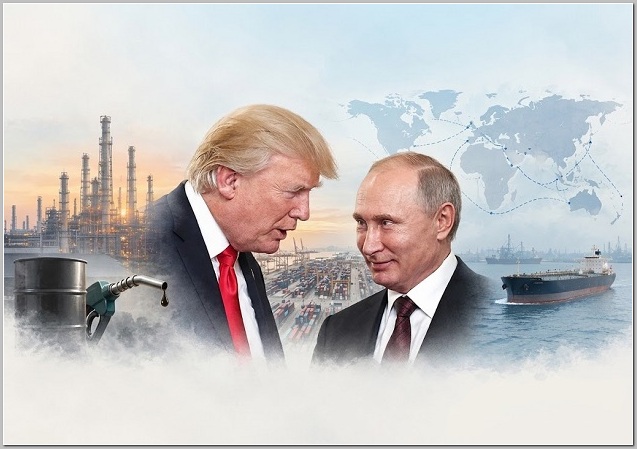
Trump announced that Russia had agreed to release more than 300,000 tons of diesel immediately, followed by another 500,000 tons in November and a further one million tons later. Russian President Vladimir Putin confirmed Moscow’s willingness to supply oil and petroleum products to the US and international markets. Washington subsequently announced a temporary general license to facilitate Russian diesel supplies to the global market.
The arrangement comes as the US-Israel war on Iran has disrupted energy flows through the Strait of Hormuz, a critical route for global oil and gas shipments. Attacks on Saudi Arabia’s East-West Pipeline and security threats around the Red Sea and Bab al-Mandeb Strait have compounded the disruptions. Damage to energy infrastructure in Russia and Ukraine has added further pressure on global fuel availability.
The consequences extend beyond the United States. Higher diesel prices increase freight, agricultural production, and manufacturing costs, potentially feeding inflation across import-dependent economies. Countries reliant on fuel imports could face rising transport expenses, pressure on foreign-exchange reserves, and higher consumer prices. Prolonged disruptions could also complicate monetary policy and economic recovery in emerging markets.
However, Russia’s capacity to deliver the promised volumes remains uncertain. Ukrainian attacks on Russian refineries and export infrastructure have reduced Moscow’s fuel-export capacity, while domestic shortages have prompted restrictions on diesel exports. Analysts have questioned whether Russia can increase supplies without putting further pressure on its own market.
The deal also exposes a contradiction in Washington’s Russia policy. The US banned Russian oil imports in 2022 following Moscow’s invasion of Ukraine, while recently expanded sanctions increased pressure on countries purchasing Russian energy. A temporary exemption for diesel suggests that immediate energy-security concerns can override broader strategic objectives when domestic prices become politically sensitive.
For Trump, reducing fuel costs is particularly important before the November 3 midterm elections, given diesel’s central role in agriculture and freight transportation. Internationally, however, the arrangement may offer only temporary relief rather than a lasting solution.
Its ultimate significance will depend on actual deliveries, shipping conditions, and the duration of supply disruptions. The deal demonstrates that sanctions and geopolitical rivalries cannot easily insulate global energy markets from the consequences of a wider crisis.