Senior Correspondent, Dhaka:
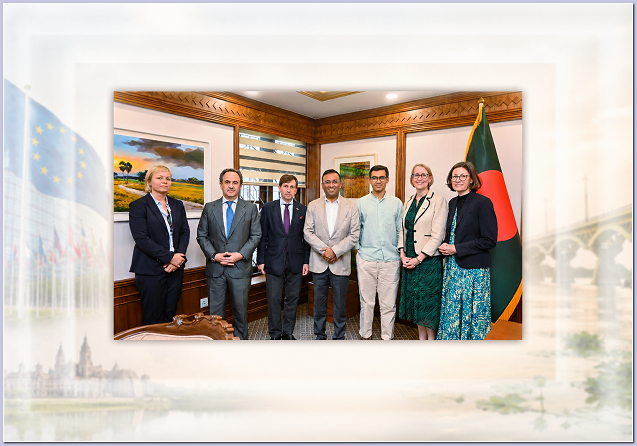
Bangladesh’s renewed engagement with European partners highlights a broader strategic shift beyond traditional diplomacy, with the Bangladesh-Europe Strategic Partnership emerging as a central pillar of the country’s economic and geopolitical agenda. Meetings held in Dhaka between senior government officials and ambassadors from France, the United Kingdom, Spain, Germany and the European Union reflected a shared commitment to expanding cooperation in trade, investment, civil aviation and other strategic sectors amid changing global economic dynamics.
The discussions underscore Europe’s growing interest in Bangladesh as the country prepares for its graduation from the Least Developed Country (LDC) category in 2026. Maintaining preferential market access, attracting quality foreign investment and strengthening industrial competitiveness have become key priorities for Dhaka, making deeper engagement with European partners increasingly important.
One of the most significant outcomes of the meetings was Bangladesh’s expression of interest in procuring Airbus aircraft for Biman Bangladesh Airlines. Rather than representing a routine fleet expansion, the proposal signals the government’s intention to diversify its aviation partnerships and establish a sustainable mixed fleet. Such a move could enhance operational flexibility while reducing dependence on a single aircraft manufacturer, provided commercial viability and national interests remain the guiding principles.
The evolving Bangladesh-Europe Strategic Partnership also reflects Europe’s broader Indo-Pacific engagement strategy, which increasingly views Bangladesh as an important economic and strategic partner. Beyond aviation, discussions covered trade, investment, defense cooperation and infrastructure development, indicating that bilateral relations are expanding into areas with long-term geopolitical significance.
Equally important is the presence of Bangladesh Investment Development Authority (BIDA) in the dialogue, demonstrating that economic diplomacy has become central to the government’s foreign policy. Bangladesh seeks not only increased investment but also technology transfer, industrial collaboration and sustainable infrastructure development that can support long-term economic transformation.
For Europe, Bangladesh represents one of Asia’s fastest-growing consumer markets and a key manufacturing hub. For Bangladesh, stronger European engagement offers opportunities to diversify export markets, modernize critical sectors and strengthen institutional cooperation ahead of the post-LDC era.
As global supply chains continue to evolve and geopolitical competition intensifies, the latest diplomatic engagements indicate that Bangladesh and its European partners are laying the foundation for a more comprehensive relationship. If translated into concrete investments and policy cooperation, the expanding partnership could become one of the defining pillars of Bangladesh’s economic and strategic diplomacy over the coming decade.