
Senior Correspondent, Dhaka:
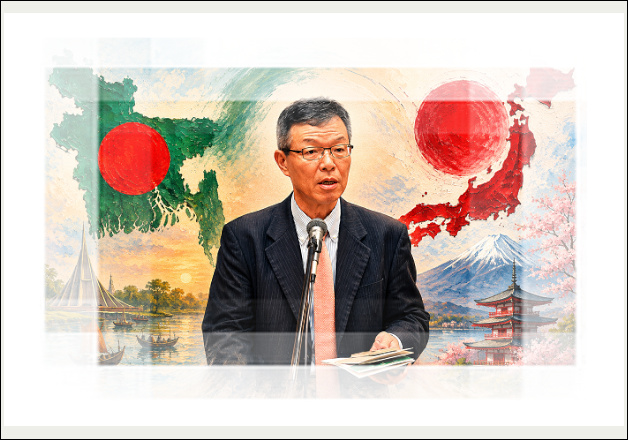
Japanese Ambassador to Bangladesh Saida Shinichi has outlined a broad and strategically significant roadmap for future Japan-Bangladesh cooperation, emphasizing Tokyo’s commitment to working with Dhaka in advancing a “Free and Open Indo-Pacific (FOIP).” His remarks reflect not only diplomatic goodwill but also Japan’s growing geopolitical and economic interest in Bangladesh as a critical partner in the Bay of Bengal region.
The envoy’s statement comes at a time when Bangladesh is undergoing a new political transition following the formation of the BNP-led government under Prime Minister Tarique Rahman. By congratulating Bangladesh on what he termed a “historic achievement,” Japan signaled its readiness to engage closely with the new administration and maintain continuity in bilateral cooperation despite the political changes since 2024.
A key takeaway from the statement is Japan’s attempt to elevate Bangladesh’s importance within its evolving Indo-Pacific strategy. Tokyo’s recently announced “Updated FOIP” concept aims to promote regional stability, connectivity, and economic prosperity across the Indo-Pacific. In this framework, Bangladesh’s geographic position along the Bay of Bengal gives it growing strategic relevance as a bridge between South Asia and Southeast Asia.
Japan’s emphasis on security cooperation marks a notable shift in bilateral relations. The signing of the defense equipment and technology transfer agreement earlier this year, along with plans to provide patrol boats to the Bangladesh Navy under Japan’s Official Security Assistance framework, indicates that ties are gradually expanding beyond development assistance into defense and maritime collaboration. This aligns with Tokyo’s broader regional security priorities amid increasing geopolitical competition in the Indo-Pacific.
Economically, Japan appears determined to deepen its long-term footprint in Bangladesh. The recently signed Economic Partnership Agreement (EPA) could significantly boost trade, investment, and industrial cooperation. Importantly, Japan highlighted that Japanese companies maintained operations in Bangladesh even during political uncertainty, underscoring investor confidence in the country’s economic potential.
The statement also reaffirmed Japan’s continued support for mega infrastructure projects under the Bay of Bengal Industrial Growth Belt (BIG-B) initiative, including the Dhaka Mass Rapid Transit, the third terminal of Hazrat Shahjalal International Airport, and the Matarbari Deep Sea Port. These projects are central to Bangladesh’s connectivity and industrial ambitions.
Overall, the ambassador’s remarks indicate that Japan sees Bangladesh not merely as a development partner, but increasingly as a strategic stakeholder in shaping the future economic and security architecture of the Indo-Pacific region.