Anwar Shahadat, New York.
The recent diplomatic engagement between the United States and India reflects a continued effort by both countries to deepen their strategic cooperation. High-level discussions and joint statements during recent interactions involving U.S. Secretary of State Marco Rubio and senior Indian foreign policy leadership underscore the growing momentum in bilateral relations.
These developments point to a broader trajectory in U.S.–India ties, where cooperation is increasingly framed around long-term strategic alignment rather than short-term diplomatic exchanges. Key areas of focus include security collaboration, trade relations, and regional stability within the Indo-Pacific framework.
While these interactions are fundamentally bilateral, their significance extends well beyond Washington and New Delhi. Across South Asia, such developments are being closely observed due to the interconnected nature of regional geopolitics. Changes in relationships between major powers often generate ripple effects that influence neighboring states and regional alignments.
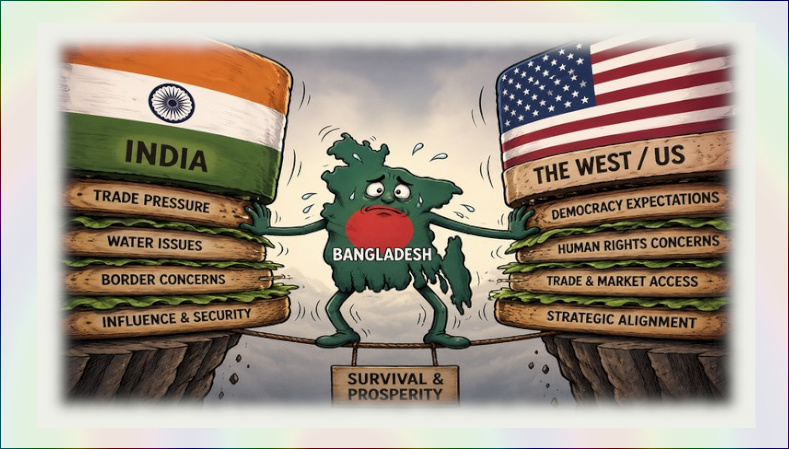
Regional Balance and Competing Influences—Within this broader strategic environment, the evolving U.S.–India relationship may carry indirect implications for Bangladesh. Positioned at a critical geographic and economic crossroads in South Asia, Bangladesh continues to attract attention from multiple global actors.
India, the United States, and China remain deeply engaged in the region, each pursuing influence through trade partnerships, infrastructure development, investment initiatives, and diplomatic outreach. This results in a competitive yet interlinked geopolitical environment in which Bangladesh must carefully balance its foreign policy priorities.
As a result, Bangladesh often navigates overlapping spheres of influence while seeking to maintain strategic autonomy and safeguard its national interests.
How U.S.–India Relations Shape Regional Perceptions—Shifts in U.S.–India relations are therefore closely monitored across South Asia. Even when not directly connected to Bangladesh, these developments can influence how regional power structures are perceived and interpreted.
Stronger cooperation between Washington and New Delhi is often viewed as reinforcing a broader strategic architecture in the Indo-Pacific. This perception can shape expectations regarding diplomatic alignments, economic partnerships, and security cooperation across nearby countries.
At the same time, China’s sustained presence in South Asia adds further complexity. Through long-term infrastructure investments and economic engagement, Beijing continues to play a significant role in shaping the region’s multipolar balance of influence.
Overall, the evolving U.S.–India partnership is not only a matter of bilateral diplomacy but also part of a wider strategic context that influences perceptions and policy calculations across South Asia.
For Bangladesh, this underscores the importance of viewing regional diplomacy within a multipolar framework shaped by the competing and overlapping interests of major global powers, including the United States, India, and China.