Senior Correspondent, Dhaka:
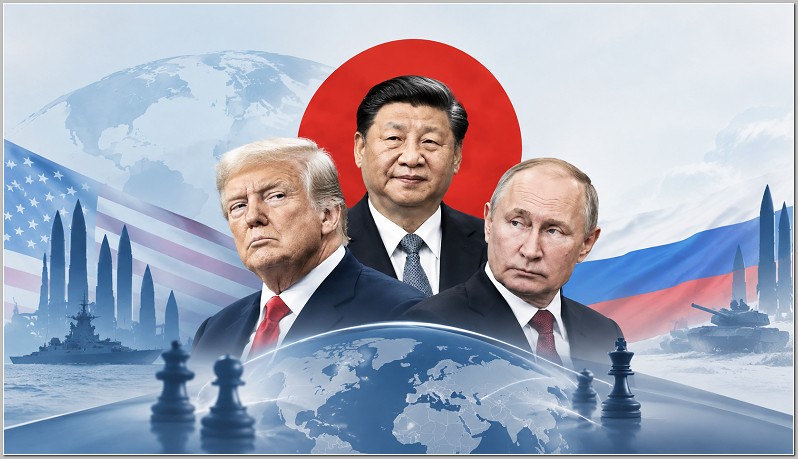
US President Donald Trump has expressed willingness to hold trilateral arms-control talks with Chinese President Xi Jinping and Russian President Vladimir Putin as early as next month, opening a potential diplomatic channel that could reshape nuclear negotiations and raise questions about Washington’s alliances.
Speaking outside the White House on Monday, Trump said the proposed meeting would focus on nuclear weapons and denuclearization while also allowing discussions on trade. The possibility of a summit on the sidelines of the November 18–19 Asia-Pacific Economic Cooperation (APEC) summit in China has reportedly been under discussion at the White House for several weeks.
Such a meeting would be unprecedented, bringing together the leaders of the world’s three largest nuclear powers. An agreement could help reduce strategic tensions and establish a framework for future arms control. However, differences over nuclear capabilities, regional security, and the terms of negotiations could make progress difficult.
Russia possesses the largest stockpile of nuclear warheads, followed by the United States and China, according to the Stockholm International Peace Research Institute. Yet Beijing has resisted joining trilateral disarmament negotiations, arguing that its nuclear capabilities remain substantially below those of Washington and Moscow. This disparity presents a major obstacle to any common agreement.
The expiration of the New START treaty, which limited US and Russian strategic nuclear arsenals, has added urgency to efforts to establish a new framework. Any broader arrangement involving China would require negotiations on verification, transparency, and limits acceptable to all three countries.
The proposed meeting could also intersect with the war in Ukraine. Trump has recently moved to ease certain restrictions on Moscow and improve ties with Putin, drawing criticism from Ukrainian President Volodymyr Zelenskiy. Trump has questioned Zelenskiy’s role in negotiations, while Russia continues its military campaign against Ukraine.
Putin has reportedly suggested using the potential meeting to discuss ending the conflict on terms favorable to Moscow. Such an approach could complicate relations with European allies, who remain concerned about Russia’s actions and the implications of any settlement reached without meaningful Ukrainian participation.
For Washington, the challenge would be to pursue nuclear risk reduction without weakening its commitments to European and Indo-Pacific partners. Whether the proposed summit produces concrete negotiations or remains an exploratory diplomatic initiative will depend on the willingness of all three powers to reconcile competing security interests.