AIP Wire report:
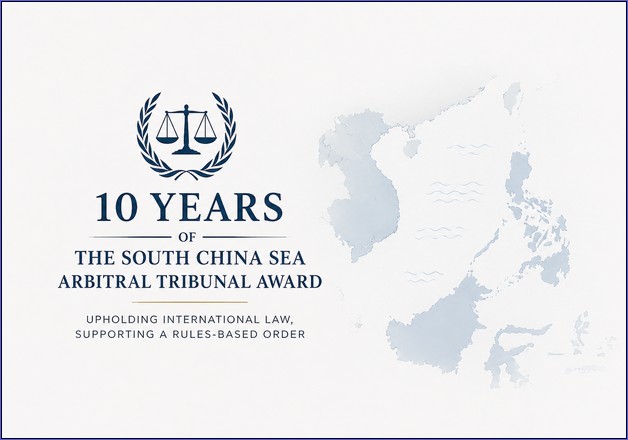
Ten years after the landmark 2016 arbitral ruling on the South China Sea arbitration remains one of the Indo-Pacific’s most consequential geopolitical flashpoints. A joint statement issued by the United States, the Philippines, Japan, Australia, and several European and Indo-Pacific partners reaffirmed that the tribunal’s decision remains final and legally binding under international law, while reiterating support for freedom of navigation, peaceful dispute resolution, and the rules-based maritime order.
The 2016 ruling, issued under the United Nations Convention on the Law of the Sea (UNCLOS), concluded that there was no legal basis for China’s expansive “historic rights” claims in much of the South China Sea. Beijing has consistently rejected the tribunal’s jurisdiction and continues to maintain that the award is “null and void,” reaffirming its sovereignty claims over much of the disputed waters.
The anniversary comes amid continuing maritime tensions between China and the Philippines, particularly around contested features in the South China Sea. Encounters involving coast guard and maritime vessels have kept the issue at the forefront of regional security discussions, prompting renewed diplomatic support from the United States and its allies for Manila and for adherence to international law.
Beyond the legal aspects, the South China Sea has become a central arena of strategic competition in the Indo-Pacific. The waterway carries a significant share of global maritime trade and is viewed as vital to regional commerce, energy security, and military mobility. As a result, developments in the area increasingly influence broader relations between China, the United States, and their regional partners.
For Washington and like-minded countries, the anniversary serves as an opportunity to reinforce support for a rules-based international order and freedom of navigation. For Beijing, the dispute remains closely linked to issues of sovereignty and territorial integrity, with Chinese officials arguing that outside involvement complicates regional stability rather than contributing to it.
A decade after the tribunal’s decision, the legal positions of the parties South China Sea arbitration ruling remain largely unchanged, but the strategic environment has evolved considerably. Increased naval deployments, expanding security partnerships, and closer defense cooperation among regional states illustrate how the South China Sea has become more than a territorial dispute—it is now a defining element of the wider Indo-Pacific security landscape.
While no immediate resolution appears likely, the continued emphasis on diplomacy, international law, and crisis management reflects a shared interest among many regional actors in preventing maritime disputes from escalating into broader confrontation. As geopolitical competition continues to shape the Indo-Pacific, the South China Sea is expected to remain a key test of how regional stability and international maritime norms are managed in the years ahead.