Senior Correspondent, Dhaka:
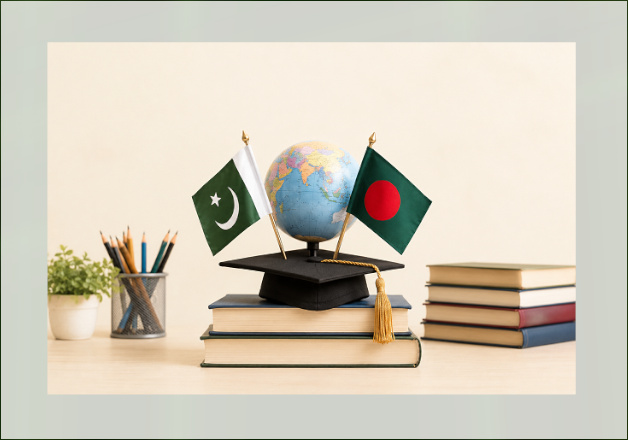
The launch of the second phase of the Allama Muhammad Iqbal Scholarships under the Pakistan–Bangladesh Knowledge Corridor reflects a growing effort by Dhaka and Islamabad to strengthen ties through education and youth engagement.
The Pakistan Education Expo 2026, inaugurated in Dhaka on Monday, brought together representatives from 20 Pakistani universities to promote scholarship and higher education opportunities for Bangladeshi students. The initiative follows Pakistan Deputy Prime Minister and Foreign Minister Senator Muhammad Ishaq Dar’s visit to Bangladesh in August 2025, when Islamabad announced 500 scholarships for Bangladeshi students.
Analytically, the program represents a broader use of education diplomacy as a strategic tool to rebuild long-term bilateral relations. Rather than focusing solely on political engagement, both countries appear to be prioritizing academic cooperation, institutional connectivity and people-to-people ties.
For Pakistan, the scholarship program is an important soft-power initiative. By opening its universities to Bangladeshi students, Islamabad is seeking to create lasting academic and cultural connections with Bangladesh’s younger generation. Such exchanges often help improve mutual perceptions and strengthen future cooperation in areas beyond education.
For Bangladesh, the initiative expands international study opportunities at a time when demand for overseas higher education continues to grow. Fully funded scholarships in fields such as science, engineering, medicine and technology may attract students seeking affordable alternatives to traditional destinations.
The participation of Education Minister Dr ANM Ehsanul Hoque Milon and senior education officials also signals Dhaka’s willingness to engage in practical cooperation where educational and research benefits are evident. Milon described the Knowledge Corridor as a platform that could strengthen academic and research collaboration between the two countries.
The initiative also carries wider regional significance. South Asian countries are increasingly using education, innovation and research partnerships to strengthen diplomatic relations and build long-term influence. In this context, the Pakistan–Bangladesh Knowledge Corridor may evolve beyond scholarships into broader university partnerships, faculty exchanges and joint research programs.
Politically, the program reflects efforts by both governments to shape a forward-looking bilateral agenda centered on youth development and institutional cooperation. The reference to the “shared vision” of Pakistan Prime Minister Muhammad Shahbaz Sharif and Bangladesh Prime Minister Tarique Rahman highlights attempts to project relations through future-oriented cooperation rather than historical divisions.
The decision to organize similar education expos in Barishal, Rajshahi, Sylhet, Chattogram and Rangpur indicates that the initiative is intended to reach students across Bangladesh, not just in Dhaka.
If sustained effectively, the scholarship program could become a significant pillar of Bangladesh–Pakistan engagement, using education as a bridge for deeper and more stable bilateral relations.