Staff Correspondent, Dhaka:
Foreign ministers from eight countries have called for renewed diplomacy to prevent further escalation in the Middle East, as tensions involving Iran, the United States, Israel, and regional actors threaten energy security and international maritime trade.
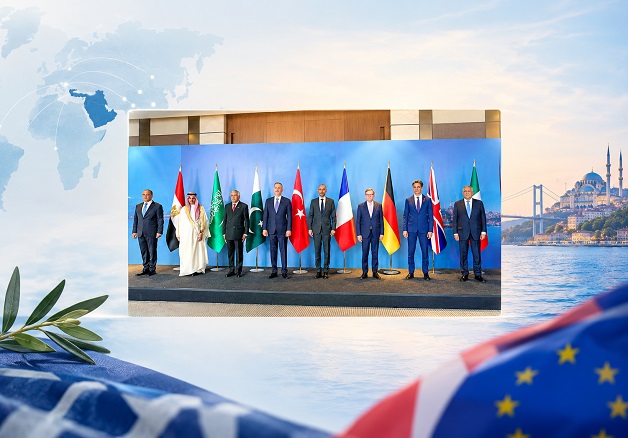
The meeting in Istanbul on Friday brought together foreign ministers from the United Kingdom, France, Germany, and Italy with counterparts from Turkey, Saudi Arabia, Pakistan, and Egypt. The gathering reflected growing concern among European and Middle Eastern governments over the potential consequences of renewed military confrontation.
Turkish Foreign Minister Hakan Fidan said the countries had agreed to urge all parties to prioritize diplomacy over further conflict. He warned that another attack on Iran could widen the war while stressing the need to reopen the Strait of Hormuz and halt attacks on Saudi Arabia.
French Foreign Minister Jean-Noel Barrot said a renewed escalation between Washington and Tehran would produce no winners. Pakistan’s Foreign Ministry said the discussions focused on the urgent need for diplomatic solutions and efforts to prevent hostilities from resuming.
The talks come amid reports that the United States and Israel have considered further military operations against Iran. Tehran, meanwhile, has warned of a broader response to any new attack. The continuing US military blockade of Iranian seaports and restrictions on shipping through the Strait of Hormuz have added to uncertainty over regional security and global energy supplies.
Maritime security emerged as another central concern. The ministers discussed freedom of navigation in the Gulf, Red Sea, and Black Sea, where reported attacks on vessels have raised concerns about additional disruptions to international trade routes.
The meeting also addressed attacks by Iran-backed Houthi forces on Saudi Arabia. Turkey has indicated opposition to offensive operations against the Houthis in Yemen, highlighting differences among regional partners over how to address the security threat.
The ministers agreed to maintain regular consultations, according to Barrot, although details of the proposed diplomatic framework were not disclosed.
The economic stakes extend beyond the region. Disruptions to shipping and energy supplies can increase transport costs, fuel prices, and inflation, placing additional pressure on households and businesses already facing higher living expenses.
The Istanbul initiative therefore reflects a shared interest in containing the conflict, although differences over military responses, regional security, and navigation rights could complicate efforts to secure a lasting settlement.