Sadik Sagar, Dhaka:
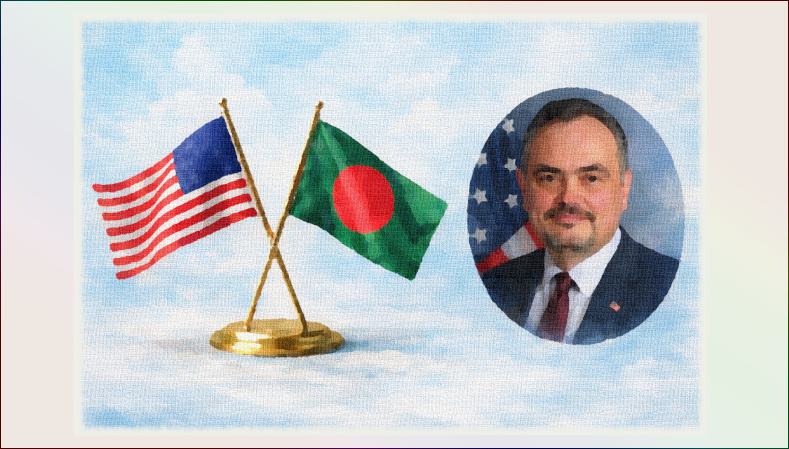
Since assuming his post in Dhaka, Brent T Christensen has undertaken an extensive series of high-level meetings, indicating a methodical and broad-based effort by the United States to deepen engagement with Bangladesh across strategic, economic, and institutional domains.
The ambassador’s April 5 meeting with Prime Minister Tarique Rahman appears to have set the overarching framework for this engagement. Discussions on economic cooperation, governance, and sustainable development priorities suggest a recalibration towards a more structured and long-term partnership. The timing and prominence of this meeting underscore Washington’s intent to align its bilateral agenda with Bangladesh’s evolving development trajectory.
Subsequent engagements reveal a deliberate sector-by-sector outreach. Meetings with Foreign Minister Khalil Rahman and Home Affairs Minister Salahuddin Ahmed highlighted continued US interest in security cooperation, particularly in counterterrorism, border management, and irregular migration. Parallel discussions with Law Minister Md Asaduzzaman Asad reinforce this focus, pointing to a coordinated approach that links legal frameworks with enforcement priorities.
Economic diplomacy forms another central pillar. Engagements with Finance Minister Khasru and Minister Mohammad Amin Ur Rashid, who oversees agriculture, fisheries, and food, reflect US efforts to strengthen trade linkages while supporting Bangladesh’s food security agenda. The emphasis on US agricultural exports and supply chains suggests a mutually beneficial, though strategically aligned, economic partnership.
At the same time, meetings with Post and Telecommunications Minister Faqir Mahbub Anam and Civil Aviation and Tourism Minister Afroza Khanam Rita point to growing US interest in Bangladesh’s emerging sectors—particularly digital infrastructure and aviation—where American firms could play a larger role. Discussions with Education Minister Dr ANM Ehsanul Hoque Milon and Health Minister Sarder Md Sakhawat Hossain further indicate a soft-power dimension focused on human capital and global health security.
Infrastructure and climate cooperation have also featured prominently. The April 12 meeting with Minister Shaikh Rabiul Alam on transport modernization, alongside talks with Environment Minister Abdul Awal Mintoo and State Minister Sheikh Faridul Islam, underscores a shared emphasis on sustainable development, climate resilience, and green growth.
Policy analysts view the breadth of these engagements as indicative of a “whole-of-government” diplomatic approach. According to Dhaka-based international relations experts, the US appears to be pursuing a dual-track strategy—strengthening traditional security cooperation while expanding economic and technological partnerships to remain a relevant and competitive partner in Bangladesh’s development landscape.
Experts also note that the frequency and diversity of meetings suggest a shift from transactional diplomacy to a more institutionalised engagement model. “This is less about individual agreements and more about embedding cooperation across ministries,” one analyst observed, adding that such an approach could provide greater continuity in bilateral relations.
Overall, Ambassador Christensen’s early diplomatic activity reflects a calibrated effort to broaden the scope of US–Bangladesh relations, positioning the partnership within a wider framework of strategic, economic, and sustainability-driven cooperation.