Sadik Sagar, Dhaka:
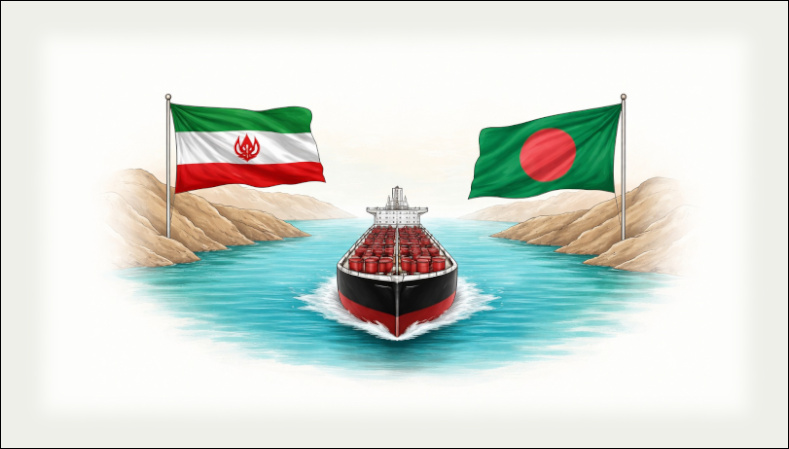
Iran’s decision to allow safe passage for Bangladesh-bound energy vessels through the Strait of Hormuz marks a significant geopolitical and economic reprieve for Dhaka at a time of acute global uncertainty. Confirmed by Iranian Foreign Minister Abbas Araghchi, the move reflects a calibrated wartime strategy by Tehran—balancing military control with selective economic accommodation for “friendly nations.”
For Bangladesh, the implications are immediate and substantial. With nearly 80% of its fuel imports transiting the strait, disruptions had exposed the country to severe supply shocks and soaring costs, particularly in LNG and crude procurement. The near-collapse of maritime traffic—down by roughly 95% in March—had forced Dhaka into expensive spot market purchases, significantly straining its energy budget and foreign exchange reserves.
Iran’s assurance effectively restores a critical supply artery. It enables Bangladesh to resume imports from key Middle Eastern suppliers such as Qatar, Oman, and Saudi Arabia at standard freight rates, reversing the cost escalations triggered by the crisis. This also reduces logistical uncertainties that had compelled contingency planning, including costly rerouting and vessel transfers.
While talking to TBS, Muhammad Fouzul Kabir Khan described the development as “comforting,” noting that the country’s heavy reliance on the route makes Iran’s assurance a crucial stabiliser. His assessment underscores the broader sentiment within policy circles that the move provides immediate relief, even as structural risks remain.
Beyond short-term gains, the development carries deeper strategic implications. Iran’s selective access policy highlights the growing fragmentation of global trade routes along geopolitical lines. By including Bangladesh alongside countries like China, India, and Russia, Tehran signals an emerging alignment shaped by energy interdependence and political pragmatism.
For Dhaka, this presents both opportunity and caution. While the immediate energy security boost is undeniable, reliance on politically conditioned access introduces long-term vulnerabilities, particularly amid evolving tensions involving the United States and Israel.
Ultimately, the episode reinforces a central lesson: in today’s volatile global order, energy security is increasingly inseparable from geopolitical positioning.