Anwar Shahadat, New York:
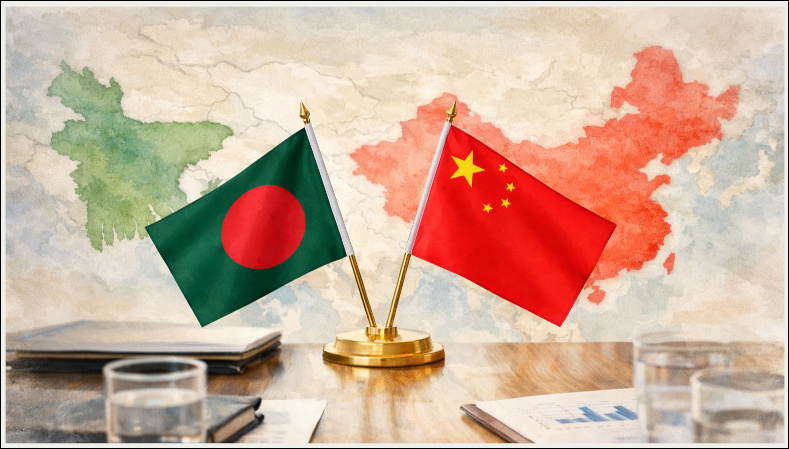
The upcoming Bangladesh–China Diplomatic Consultation Meeting is expected to review the evolving strategic, economic, and political relationship between the two countries. Held periodically between senior officials of the foreign ministries, the consultation mechanism allows Dhaka and Beijing to assess bilateral cooperation and discuss regional developments. As the two sides prepare for the 14th round of consultations in Dhaka, several geopolitical issues are likely to dominate the agenda. Among them, infrastructure and connectivity projects, trade and economic cooperation, and the broader regional strategic balance stand out as key areas of discussion.
One of the most significant issues is infrastructure development and connectivity under China’s Belt and Road Initiative (BRI). Over the past decade, China has become a major development partner for Bangladesh, financing and supporting large infrastructure projects such as bridges, power plants, highways, and port facilities. These investments have contributed to Bangladesh’s economic growth and modernization of its transport and energy sectors. During the consultations, both sides are expected to review the progress of ongoing projects and explore new areas of cooperation, particularly in logistics, industrial parks, and energy infrastructure. At the same time, Bangladesh will likely seek to ensure that future projects remain financially sustainable and aligned with its national development priorities.
Trade and economic cooperation will also be a central focus of the discussions. China is one of Bangladesh’s largest trading partners, but the relationship has long been characterized by a significant trade imbalance in China’s favor. Bangladeshi exports to China—mainly garments, leather products, and agricultural goods—remain relatively limited compared to the large volume of Chinese imports into Bangladesh. Dhaka has been pushing for greater market access and diversification of its exports to China. The consultations may therefore explore measures to expand Bangladeshi exports, attract Chinese investment in manufacturing, and strengthen cooperation in sectors such as technology, renewable energy, and the digital economy.
A third important geopolitical issue relates to the broader strategic balance in South Asia and the Indo-Pacific region. Bangladesh maintains a foreign policy that seeks balanced relations with major global and regional powers, including China, India, the United States, and Japan. As geopolitical competition intensifies in the Indo-Pacific, Bangladesh aims to benefit from economic partnerships while avoiding alignment with any particular strategic bloc. In this context, the diplomatic consultations with China provide an opportunity for both sides to discuss regional security dynamics, maritime cooperation, and economic connectivity initiatives. For Beijing, strengthening ties with Bangladesh supports its broader engagement in South Asia, while for Dhaka it provides an avenue to maintain diversified partnerships and strategic autonomy.
Overall, the Bangladesh–China Diplomatic Consultation Meeting is expected to reinforce bilateral cooperation while addressing emerging regional challenges. By focusing on infrastructure collaboration, trade expansion, and regional geopolitical stability, the dialogue reflects the growing importance of Bangladesh–China relations in shaping economic development and strategic dynamics across the wider Indo-Pacific region.