By Tanvir Rusmat, Dhaka:
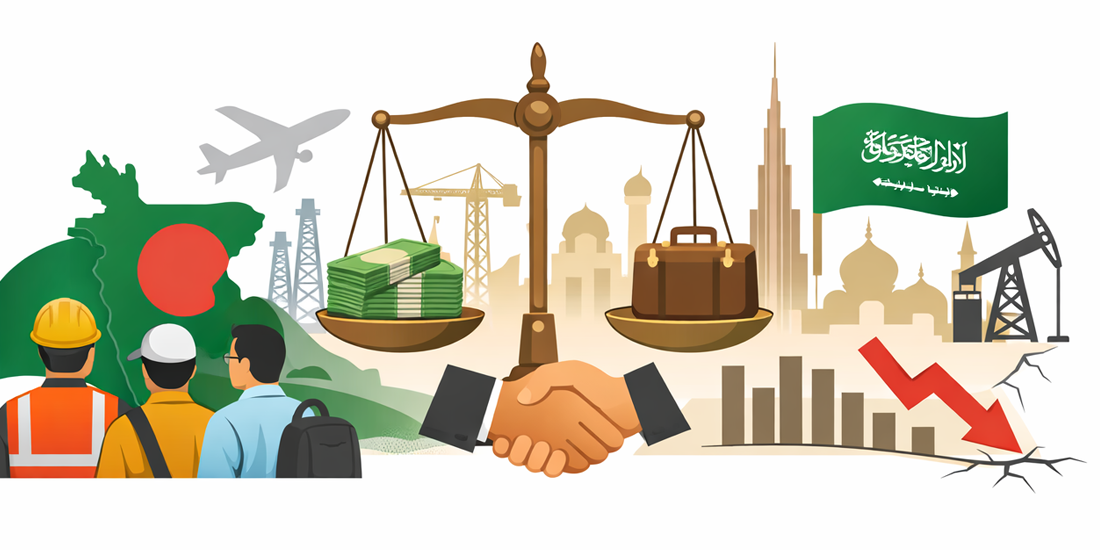
For Bangladesh, the Middle East is more than a destination for migrant labour—it is a pillar of national economic stability and a ground where foreign policy, domestic politics and regional tensions intersect.
Decades of labour migration have made Gulf states indispensable to Bangladesh’s economic health. Until recently, Saudi Arabia alone accounted for the largest share of remittances, with Bangladeshi migrants forming a deep-rooted community that fuels financial flows back home through wages sent from the Kingdom’s construction sites, domestic spheres and service sectors.
Yet the landscape is shifting. Remittance inflows from the Gulf have shown signs of weakening, according to central bank data—Saudi remittances that were once above Tk 6,500 crore in early months have steadily fallen in subsequent months, while neighbouring GCC countries such as Qatar and Oman have also seen declines. Economists warn that continued visa restrictions and tightening labour markets could sharply curtail this vital income stream.
At the same time, Bangladesh itself is grappling with a retreat in outward migration. Government statistics and independent reporting reveal a notable drop in new workers departing for Middle Eastern jobs, with overall migration figures down nearly 30% year-on-year. Closed markets in Malaysia, Oman and the UAE, coupled with slow recruitment in Saudi Arabia and Qatar, have left traditional pathways increasingly constrained.
This squeeze is not merely economic, but diplomatic. In forums such as the Abu Dhabi Dialogue, Bangladesh’s expatriates’ welfare officials have urged shared international action to protect migrant rights—a plea that underscores how much labour issues are entangled with geopolitics. As the government’s labour envoy has stressed, fair recruitment, decent working conditions and ethical migration cannot be addressed in isolation by Dhaka; they require cooperation from both sending and receiving states.
Experts and civil society voices further characterise the broader context: continuing dependence on low-skill labour export, coupled with high migration costs and systemic exploitation, undermines Bangladesh’s standing in competitive Gulf markets and threatens long-term remittance resilience. Analysts caution that unless Dhaka deepens skills training, tackles fraudulent recruiting practices, and negotiates stronger protections with host states, the existing pattern could leave remittance flows—and the wider economy—exposed to sudden shocks.
The stakes extend beyond bank balances. Gulf political tensions and labour policy shifts have a multiplier effect on Bangladeshi households reliant on overseas earnings. As remittances slow and job prospects tighten, the country’s foreign policy must balance traditional ties with emerging diplomatic challenges. From Riyadh to Abu Dhabi, Dhaka’s pursuit of labour access, worker welfare and economic stability is becoming one of South Asia’s most delicate geopolitical equations.