Senior Correspondent, Dhaka:
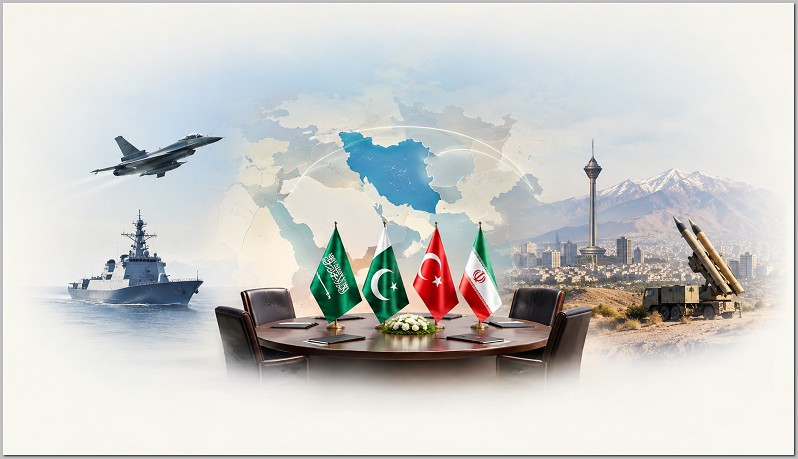
Saudi Arabia, Pakistan, and Turkey are pursuing a dual-track approach to regional security, combining collective defense commitments with direct engagement with Iran as tensions across the Middle East persist.
Senior officials from the three countries are holding talks in Tehran with Iranian counterparts, seeking ways to ease regional tensions and explore cooperation on security. The meeting comes as the Mecca Joint Defense Agreement faces pressure from attacks by Yemen’s Iran-aligned Houthi rebels against Saudi Arabia.
Signed in August 2026, the agreement stipulates that an armed attack against one member would be treated as an attack against all three, requiring collective assistance. The arrangement combines Saudi Arabia’s financial and energy-market influence, Pakistan’s military capabilities, Turkey’s defense industry, and NATO membership.
However, the pact’s defensive commitments are increasingly being tested by regional developments. At an emergency meeting in Riyadh on October 5, the three countries agreed to advance measures for implementing their collective defense obligations, including the rapid deployment of agreed military capabilities to Saudi Arabia.
Turkey has nevertheless sought to distinguish defensive assistance from participation in offensive operations inside Yemen. Foreign Minister Hakan Fidan has ruled out sending Turkish troops abroad to conduct attacks, while Ankara considers possible contributions in air defense, electronic warfare, and technical support.
Against this backdrop, engagement with Tehran reflects the countries’ interest in containing escalation without abandoning their security commitments. Pakistan has played a mediating role between Iran and Washington, while Saudi Arabia seeks to protect its territory and infrastructure. Turkey, meanwhile, has an interest in preventing a wider regional confrontation.
Saudi officials have described the Tehran visit as part of continuing efforts to reduce tensions and support mediation initiatives involving Qatar and Pakistan. Iran has also advocated an indigenous regional security framework based on the capabilities and interests of countries in the region.
Yet the two approaches are not necessarily aligned. Saudi Arabia maintains extensive security ties with the United States, Turkey remains a NATO member, and Pakistan pursues defense partnerships with multiple powers. These relationships complicate efforts to establish a common regional security mechanism.
The Tehran talks therefore do not necessarily signal a shift away from military deterrence. Rather, they highlight an attempt to combine defense preparedness with diplomacy. Whether this approach can produce lasting stability will depend on translating dialogue into practical arrangements that address mutual security concerns and reduce the risk of further escalation.