Anwar Shahadat, New York.
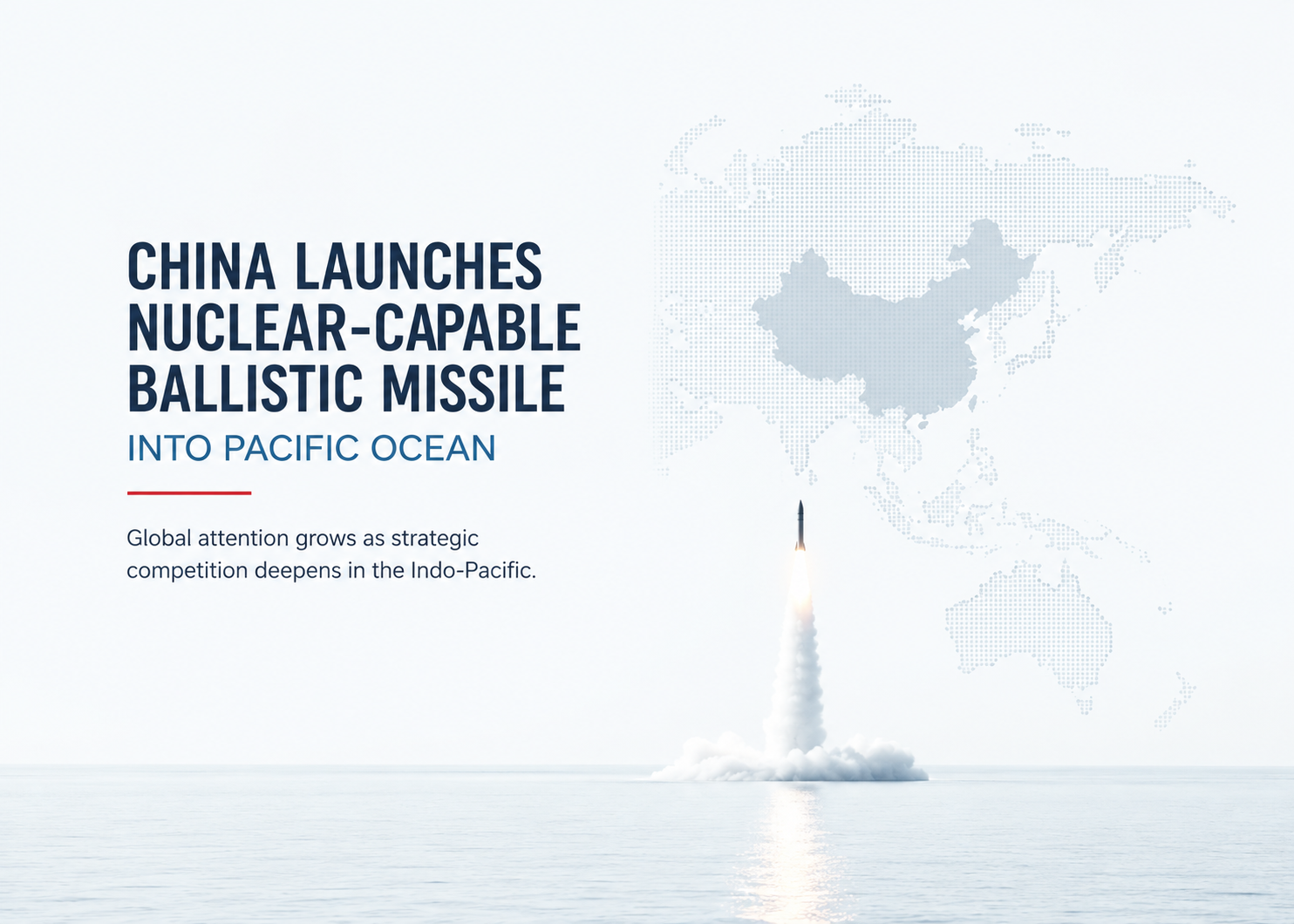
China’s recent launch of a nuclear-capable ballistic missile into the Pacific Ocean has drawn renewed international attention. While the launch was not entirely unexpected given the evolving strategic landscape, it has heightened security concerns across the Indo-Pacific. The United States and several regional partners expressed concern over the implications for regional stability and military transparency.
In a statement released by the U.S. Department of State, Washington criticized Beijing for providing only limited advance notification of the launch and argued that the level of transparency fell short of the practices generally followed by the five permanent members of the United Nations Security Council. The United States also reiterated its concern over China’s expanding nuclear capabilities and called for greater engagement on strategic stability and arms control.
According to Chinese officials, the missile launch was part of a routine military training exercise and was not directed at any specific country. Beijing has urged outside governments not to overinterpret the test, describing it as a normal component of military preparedness.
Although missile tests by major powers are not uncommon, analysts note that this launch stands out because it involved a submarine-launched ballistic missile capable of carrying nuclear warheads and occurred in the broader Pacific rather than in waters closer to China’s coastline. The event has prompted responses from Japan, Australia, New Zealand, and Taiwan, all of which emphasized the importance of transparency and regional stability.
The development comes at a time of intensifying strategic competition across the Indo-Pacific. Over the past several years, China has continued to modernize its armed forces, including its sea-based nuclear deterrent, while the United States and its allies have strengthened security cooperation through initiatives such as AUKUS, enhanced defense partnerships, and increased military coordination with regional allies. The result has been a security environment in which military demonstrations by either side are viewed through a broader geopolitical lens rather than as isolated events.
From Washington’s perspective, strategic stability depends not only on military capabilities but also on communication, transparency, and mechanisms that reduce the risk of misunderstanding during periods of heightened tension. U.S. officials have repeatedly encouraged Beijing to engage in discussions on nuclear risk reduction and arms control, although such dialogue has remained limited in recent years.
For China, the continued development of advanced missile systems is presented as part of a broader effort to strengthen national defense and maintain a credible deterrent. Chinese officials have consistently argued that their military modernization is defensive in nature and intended to safeguard national sovereignty and security interests.
While the missile launch does not by itself signal an immediate change in the regional security balance, it illustrates how military modernization and strategic signaling are becoming increasingly intertwined in the Indo-Pacific. As competition between major powers continues to evolve, actions such as missile tests are likely to be assessed not only for their technical significance but also for the political messages they convey.
For policymakers across the region, the episode underscores the continuing importance of transparency, crisis communication, and diplomatic engagement in reducing the risk of miscalculation. In an Indo-Pacific where military capabilities are expanding alongside geopolitical rivalry, maintaining open channels of dialogue may prove as important as the capabilities themselves.