Special Correspondent, Dhaka:
India has signaled that it is closely monitoring Bangladesh’s expanding engagement with China, reflecting growing regional attention to Dhaka’s evolving foreign policy and the broader geopolitical shifts taking shape in South Asia.
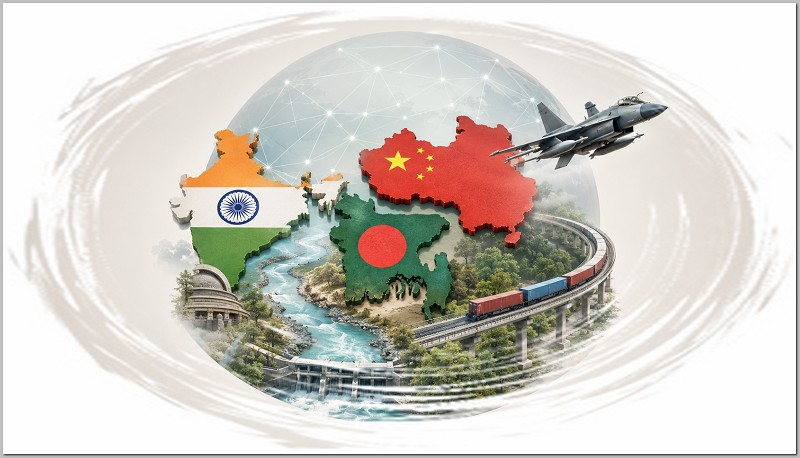
Speaking at a weekly media briefing on Friday, Indian Ministry of External Affairs spokesperson Randhir Jaiswal said New Delhi was keeping a close watch on recent developments in China-Bangladesh relations, including discussions on a proposed China-Myanmar-Bangladesh economic corridor and reports that Dhaka is exploring the acquisition of advanced Chinese fighter aircraft.
The remarks came after Prime Minister Tarique Rahman’s recent visit to Beijing, where Bangladesh and China discussed deeper economic, infrastructure and strategic cooperation. During the visit, Chinese President Xi Jinping proposed establishing a regional economic corridor linking China, Myanmar and Bangladesh—a proposal that Bangladesh has said it is currently studying.
India’s response suggests that New Delhi views these developments through a broader strategic lens rather than as isolated bilateral initiatives. The proposed corridor, if realized, could reshape regional connectivity by enhancing China’s economic footprint in the Bay of Bengal while providing Bangladesh with additional trade and logistics opportunities. However, it also raises questions about the future balance of influence in India’s immediate neighborhood.
Jaiswal said India routinely monitors developments in neighboring countries and “takes necessary measures at the right time,” indicating a cautious but measured approach. He stopped short of characterizing Bangladesh’s reported interest in Chinese military equipment as a direct security concern.
According to multiple Indian media reports, Bangladesh has expressed interest in purchasing China’s 4.5-generation J-10CE multirole fighter aircraft. While Chinese Ambassador to Bangladesh Yao Wen declined to comment publicly on the reports, the discussion itself has attracted significant regional attention because such a purchase would represent a notable expansion of defense cooperation between Dhaka and Beijing.
The issue also intersects with broader regional diplomacy surrounding the Teesta River project. Responding to questions about China’s renewed support for the river management initiative, Jaiswal reiterated that India’s development cooperation with Bangladesh follows a mutually agreed roadmap and that New Delhi would consider all relevant developments in shaping its future approach.
Taken together, India’s comments illustrate the increasingly competitive strategic environment surrounding Bangladesh. As Dhaka strengthens economic and diplomatic ties with China while maintaining longstanding relations with India, it is pursuing a balancing strategy aimed at maximizing development opportunities without formally aligning with any single power.
For Bangladesh, managing these parallel relationships will remain a defining foreign policy challenge. For India, the emphasis appears to be on sustained observation and calibrated engagement rather than immediate confrontation, underscoring the growing importance of Bangladesh in the evolving geopolitical landscape of the Indo-Pacific.