AIP Wire Report | New York.
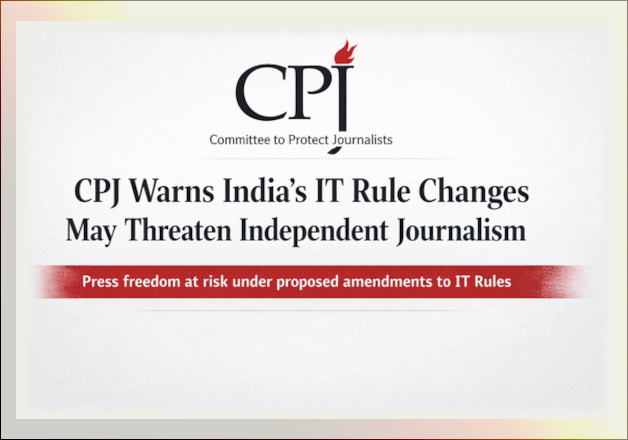
The Committee to Protect Journalists (CPJ) has urged the government of India to withdraw proposed amendments to its Information Technology (IT) Rules, warning that the changes could significantly restrict press freedom, particularly for independent digital journalists.
According to CPJ, the draft amendments would extend an existing regulatory code of ethics—currently applied to large broadcasters and streaming platforms—to individual content creators. This includes independent journalists who report on news and current affairs via social media platforms.
If implemented, the changes would require these individuals to comply with government takedown orders in a manner similar to large media organizations, effectively treating them as formal publishers.
The Indian government has stated that the amendments are necessary to address the growing challenges of misinformation and deepfake content. The proposal remains open for public consultation until April 29.
Kunal Majumder, CPJ’s Asia-Pacific Program Coordinator, expressed strong concern over the proposal, describing it as a threat to independent journalism. He emphasized that digital journalists now play a vital role in India’s media landscape and democratic accountability.
“Regulating independent journalists like large media corporations risks silencing critical reporting and further shrinking the space for press freedom,” Majumder said.
India’s digital communication ecosystem is governed by the Information Technology Act, 2000, along with its accompanying IT Rules. These regulations grant authorities the power to order the removal of online content deemed harmful to national security or public order.
Under the existing framework, digital publishers and major technology platforms must adhere to established journalistic standards and respond to government directives within strict timelines. Failure to comply—such as not removing flagged content within a three-hour window—can result in the loss of legal protections.
The proposed amendments would expand this regulatory scope by classifying individual creators and journalists on platforms such as Facebook and YouTube as publishers, placing them under direct oversight of the Ministry of Information and Broadcasting.
The development comes amid a series of recent content restrictions in India. Several news-related Facebook pages, including those operated by independent outlets, have reportedly been blocked following government directives. In another instance, a post by the magazine The Caravan on X—featuring an image of Prime Minister Narendra Modi related to the 2002 Gujarat riots—was restricted under existing IT regulations.
As of now, India’s Ministry of Electronics and Information Technology and the Ministry of Information and Broadcasting have not publicly responded to CPJ’s concerns.