
Special Correspondent, Dhaka:
Prime Minister Tarique Rahman’s visit to China has produced outcomes that extend beyond traditional diplomatic engagement, signaling a strategic deepening of Bangladesh-China relations in water management, security cooperation, and regional connectivity.
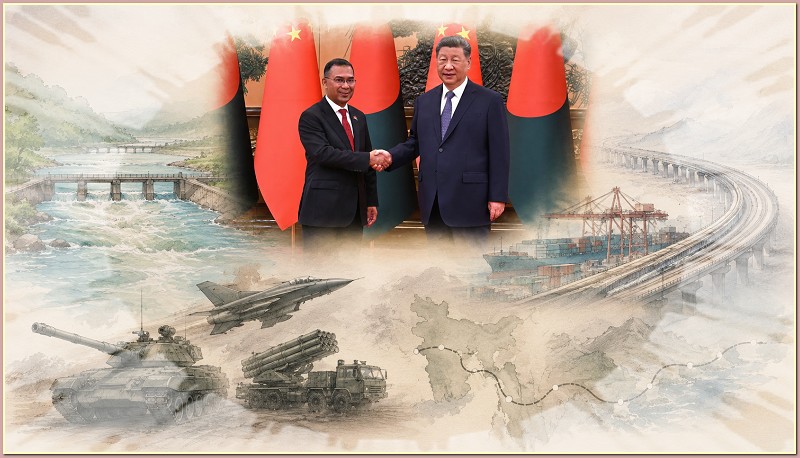
Among the most significant announcements is Beijing’s commitment to support the Teesta River Comprehensive Management and Restoration Project (TRCMRP). For Bangladesh, the Teesta issue has long been tied to water security, agricultural sustainability and regional development. China’s pledge to assist in feasibility studies and technical cooperation provides Dhaka with an alternative pathway to advance a project that has remained stalled for years due to political and diplomatic complexities.
The Teesta initiative carries implications beyond river management. If implemented, the project could transform northern Bangladesh through river restoration, flood control, irrigation expansion and economic revitalization. It also demonstrates China’s willingness to engage in strategically important infrastructure projects that directly affect Bangladesh’s development priorities. The move strengthens Beijing’s role as a key development partner while allowing Dhaka to diversify its external partnerships.
Another notable outcome is the agreement to deepen defense cooperation. The two countries agreed to expand military exchanges, training programs, official visits and discussions on security matters. More importantly, the proposal to explore a “2+2” dialogue mechanism involving foreign and defense officials suggests an institutionalization of strategic consultations.
For Bangladesh, maintaining defense cooperation with China remains crucial as Beijing continues to be one of its largest suppliers of military equipment. Enhanced defense engagement does not necessarily indicate a military alliance but reflects Dhaka’s broader strategy of maintaining balanced relations with major powers while strengthening its own defense capabilities.
The joint communiqué also highlights growing interest in regional connectivity under the Belt and Road Initiative. Although not explicitly mentioned, the commitment to explore direct connectivity and new regional transport options has revived discussions surrounding a potential Bangladesh-Myanmar-China economic corridor.
Such a corridor could connect southwestern China to the Bay of Bengal through Myanmar and Bangladesh, creating new trade routes and logistics networks. For Bangladesh, this would strengthen its position as a regional transit and manufacturing hub while opening greater access to Chinese markets. However, the corridor’s future remains closely linked to stability in Myanmar, particularly in Rakhine State.
China’s renewed commitment to facilitate dialogue between Bangladesh and Myanmar on the Rohingya crisis is therefore strategically significant. Progress on repatriation and stability in Rakhine would not only address a humanitarian challenge but also create conditions for broader regional connectivity initiatives.
Taken together, the outcomes of the Beijing visit indicate that Bangladesh-China relations are evolving from project-based cooperation toward a more comprehensive strategic partnership centered on infrastructure, security and regional integration.