Sagar Rahman, Dhaka:
Bangladesh First foreign policy is increasingly emerging as the cornerstone of Dhaka’s diplomatic strategy, as reflected in Foreign Minister Dr. Khalilur Rahman’s meetings with the top diplomats of China, the United States and Russia on the sidelines of the ASEAN Regional Forum (ARF) in Manila. The engagements highlight Bangladesh’s determination to pursue a pragmatic, interest-driven approach that seeks economic gains and strategic flexibility without becoming entangled in great-power rivalries.
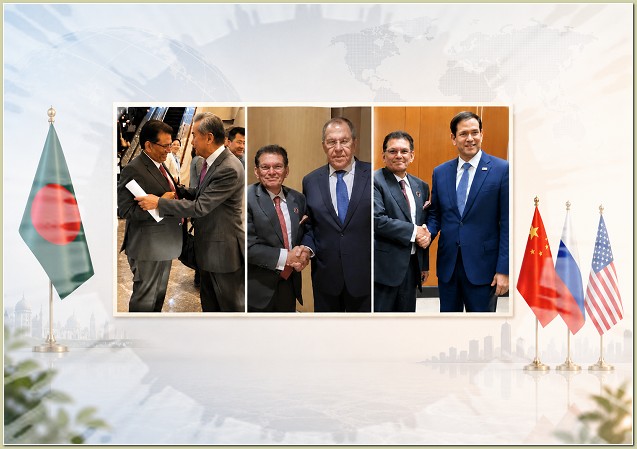
The nearly simultaneous meetings with Chinese Foreign Minister Wang Yi, Russian Foreign Minister Sergey Lavrov and US Secretary of State Marco Rubio demonstrate Dhaka’s commitment to maintaining balanced relations with all major powers. At a time when geopolitical competition is reshaping the Indo-Pacific, Bangladesh is signaling that national development, trade, investment, energy security and regional stability will remain the primary drivers of its foreign policy.
Discussions with China centered on connectivity, trade, investment, energy cooperation and the repatriation of forcibly displaced Rohingyas, reaffirming Beijing’s significance as one of Bangladesh’s leading development and infrastructure partners. Talks with Russia focused on strengthening energy cooperation, while Lavrov also congratulated Khalilur Rahman on his election as President of the 81st session of the UN General Assembly. Meanwhile, the meeting with Marco Rubio reflected Dhaka’s intention to expand economic and strategic cooperation with Washington, with the foreign minister inviting the US Secretary of State to visit Bangladesh.
The Bangladesh First foreign policy also reflects Dhaka’s growing confidence in engaging multiple global partners while preserving strategic autonomy. Rather than choosing sides, Bangladesh is positioning itself as a reliable and constructive partner capable of working with competing powers on shared interests.
As Bangladesh expands its engagement with ASEAN and prepares for a more prominent role at the United Nations, the Manila meetings suggest that Dhaka is moving beyond traditional diplomacy towards a more diversified, multidimensional foreign policy. If implemented consistently, this balanced approach could enhance Bangladesh’s global standing while creating new opportunities for trade, investment, and regional cooperation.