
Sadik Sagar, Dhaka.
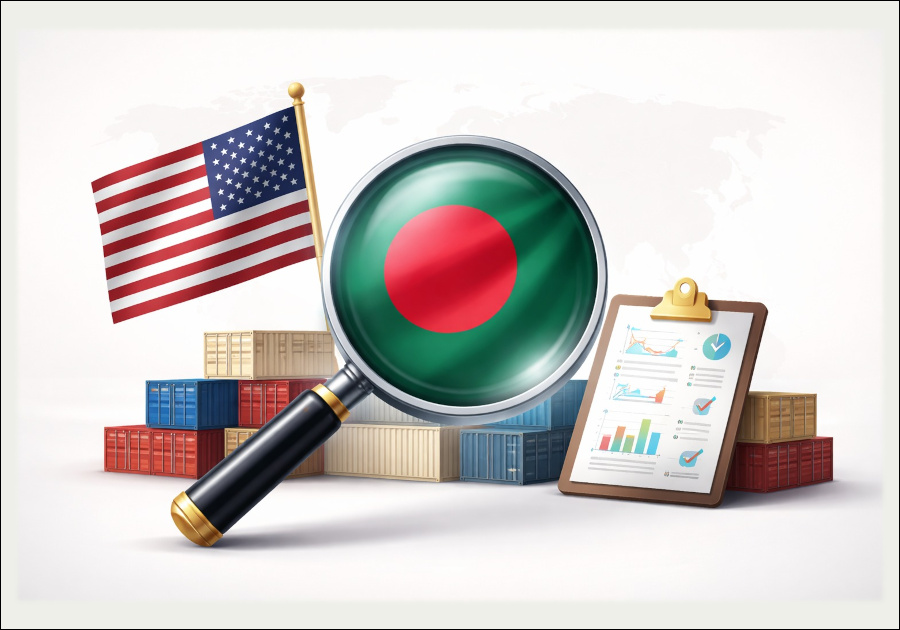
The United States has launched a trade investigation into Bangladesh and several other economies to assess whether their policies and production practices are contributing to global manufacturing overcapacity that could affect American industries. The inquiry was initiated by the Office of the United States Trade Representative (USTR) under Section 301 of the Trade Act of 1974, a mechanism used to examine trade practices considered unfair or restrictive to US commerce.
According to a statement from the USTR, the investigation will examine whether the acts, policies and practices of the identified economies are “unreasonable or discriminatory” and whether they place a burden on US trade. Alongside Bangladesh, the investigation includes China, the European Union, Singapore, Switzerland, Norway, Indonesia, Malaysia, Cambodia, Thailand, South Korea, Vietnam, Taiwan, Mexico, Japan and India.
The move comes as the United States continues efforts to strengthen domestic manufacturing and address supply-chain vulnerabilities. US Trade Representative Ambassador Greer said the investigations are part of broader efforts to support industrial capacity and employment in the United States. Washington has expressed concern that some trading partners are producing goods at levels exceeding their domestic consumption, potentially contributing to excess global supply in certain sectors.
In the case of Bangladesh, the USTR pointed to a bilateral goods trade surplus of $6.15 billion with the United States. Much of this surplus is driven by exports from the textile sector, which remains Bangladesh’s largest export industry and a key source of foreign exchange earnings.
The USTR statement also noted that Bangladesh provides export incentives across several sectors, including textiles and leather products. Such policies will be reviewed as part of the investigation to determine whether they influence trade flows in ways that could affect US commerce.
The investigation also cited examples of excess capacity in certain industries within Bangladesh, including cement production. According to the USTR, domestic consumption of cement declined to around 38 million tonnes in 2024, which represents less than 40 percent of the country’s total installed production capacity.
The USTR will open a public docket for comments on March 17, allowing stakeholders to submit written opinions and supporting materials. Interested parties may request to appear at a public hearing and submit summaries of testimony by April 15. A hearing on the matter is scheduled to take place on May 5.
The findings of the investigation could inform potential policy decisions or trade measures depending on its outcome.