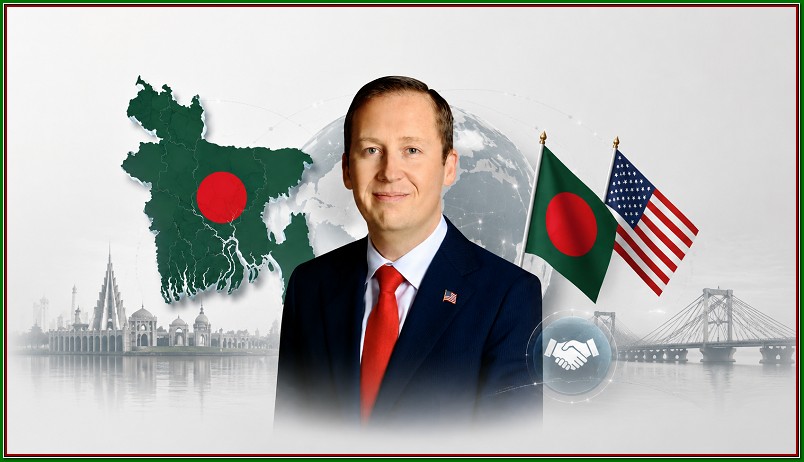
His tenure in Dhaka coincided with regime change, democratic restoration, and a defining moment in US–Bangladesh strategic engagement.
Views by AIP Wire, New York.
William B. Milam and the Democratic Crossroads of Bangladesh
His tenure in Dhaka coincided with regime change, democratic restoration, and a defining moment in US–Bangladesh strategic engagement.
Views by AIP Wire, New York.
“Diplomacy matters most when a nation stands at the edge of political transformation.”
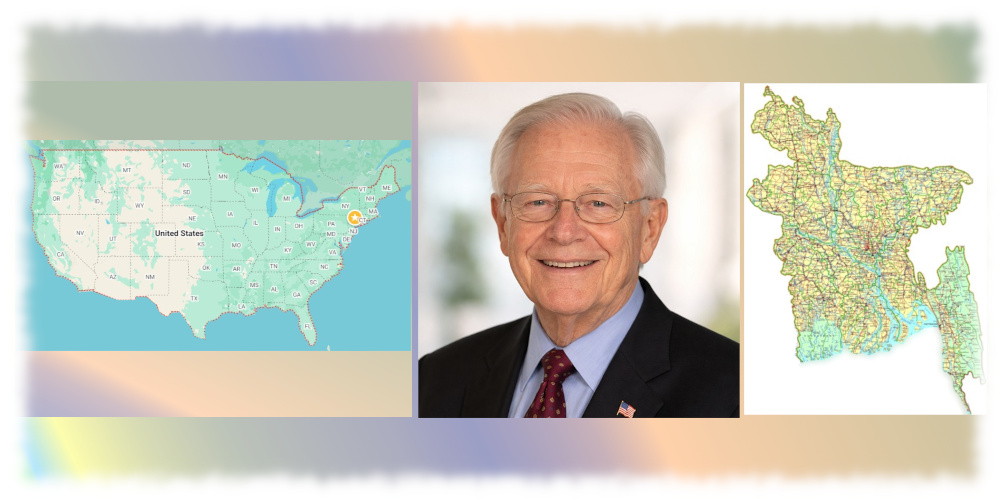
The passing of former United States Ambassador to Bangladesh William B. Milam is not merely the loss of a seasoned diplomat; it is the closing of a chapter tied to one of Bangladesh’s most consequential political transitions.
From 1990 to 1993, Ambassador Milam served in Dhaka during the fall of President Hussain Muhammad Ershad’s autocratic regime and the restoration of parliamentary democracy. That period marked Bangladesh’s re-entry into competitive politics after nearly a decade of military-backed rule. It was a volatile moment—charged with political mobilisation, institutional uncertainty, and high public expectation.
Milam’s tenure intersected with that turning point.
Democracy, Diplomacy, and Strategic Timing: The early 1990s were transformative globally. The Cold War had ended. Washington’s foreign policy recalibrated toward supporting democratic transitions across Asia, Africa, and Eastern Europe. South Asia was no exception.
In Bangladesh, the United States’ diplomatic posture under Milam was defined by steady engagement rather than overt pressure. His presence during the transition signaled American support for institutional continuity, electoral legitimacy, and political stabilization.
While diplomacy rarely makes headlines, its quiet influence can be decisive. In moments of democratic flux, reassurance from international partners helps reinforce confidence in electoral processes and governance structures. Milam’s tenure coincided precisely with that need.
Operation Sea Angel: Humanitarian Diplomacy in Action: If one event symbolized his impact, it was Operation Sea Angel in 1991.
After the devastating cyclone and floods that killed tens of thousands and displaced millions, the United States launched one of its largest humanitarian operations in South Asia. Coordinated during Milam’s tenure, the mission deployed thousands of US military personnel to assist in relief and recovery efforts.
Operation Sea Angel did more than save lives.
It strengthened bilateral trust. It demonstrated operational partnership. It embedded humanitarian cooperation into the foundation of US–Bangladesh relations. Even decades later, it remains one of the most significant examples of US disaster response engagement in the region.
In strategic terms, it reinforced Washington’s image as a reliable partner during crisis — an image that continues to shape perceptions of American engagement in Bangladesh.
A Diplomat of Transitional Moments: Milam’s career suggests a pattern: he was often present where systems were shifting.
After Bangladesh, he served as US Ambassador to Liberia (1995–1998), where civil war concluded and democratic elections were held. Later, as Ambassador to Pakistan (1998–2001), he navigated nuclear tensions and political instability. Following his retirement, he was recalled after the September 11 attacks to help establish multilateral reconstruction mechanisms for Afghanistan.
Such assignments are not coincidental. They reflect institutional trust in a diplomat capable of operating in politically sensitive environments.
The Bangladesh Context Today: Bangladesh today again stands amid debates over democratic processes, electoral credibility, and geopolitical balancing between major powers. The strategic environment is more complex, shaped by US–China competition, Indo-Pacific recalibration, and evolving regional alignments.
Remembering Milam’s tenure invites reflection.
In the early 1990s, US engagement with Bangladesh was framed by democratic encouragement and humanitarian partnership. Today, the bilateral relationship encompasses trade, security cooperation, labor rights discussions, sanctions debates, and Indo-Pacific strategy considerations.
The foundational trust built during earlier decades — including during Milam’s tenure — still underpins that relationship.
Legacy and Perspective: William B. Milam passed away at the age of 89 in Sacramento, California. A career Foreign Service officer since 1962, he received numerous honors, including the James Clement Dunn Award (1981), a Superior Honor Award (1983), the Presidential Meritorious Service Award (1990), and the Presidential Award for Outstanding Service (1991).
But beyond awards, his legacy in Bangladesh rests on two pillars: Steady diplomatic engagement during democratic transitio, Humanitarian leadership during national crisis.
Diplomats rarely reshape history alone. Yet they help steady the ground on which history unfolds. As Bangladesh continues navigating its own evolving democratic trajectory, recalling figures like William B. Milam underscores a simple but enduring truth: diplomacy, when measured and principled, can reinforce institutions at moments when they matter most.