A closer look at what schools are doing—and what still needs attention
By Afifa Khanam, New York:
New York City is home to one of the largest and most diverse public school systems in the country. In the 2025–26 school year, NYC Public Schools (NYCPS) reported 884,644 students across 1,599 schools. With such a large and diverse student population, creating schools where students feel safe and respected is a major responsibility.
For LGBTQ+ students, that responsibility can be particularly important. Schools are not only places where students learn. They are also places where young people build friendships, develop their identities, find trusted adults, and spend a large part of their everyday lives.
NYC Public Schools has put a number of programs and policies in place to support LGBTQ+ students. These include anti-bullying protections, gender and sexuality alliances, staff training, guidance for supporting transgender and gender-expansive students, inclusive curriculum resources, and connections to community organizations.
The bigger question, however, is whether these efforts reach students consistently in individual schools—and whether teachers and parents receive enough information to make those policies work in practice.
What NYC Public Schools Already Has in Place
NYCPS has a specific webpage dedicated to LGBTQ+ supports. The system’s policy explicitly protects students from discrimination, harassment, intimidation, and bullying based on characteristics including sexual orientation, gender identity, and gender expression. ()
One of the most important programs is Respect for All, the city’s system-wide approach to bullying and harassment. The program has been operating since 2007 and requires schools to have procedures for dealing with bullying and discrimination. LGBTQ+ identity is specifically included within these protections.
This is important because LGBTQ+ students should not have to depend entirely on whether an individual teacher happens to be supportive. There is a formal school-system responsibility to respond when harassment occurs.
NYCPS also has specific guidelines for transgender and gender-expansive students. These guidelines cover issues that can arise in everyday school life, including names and pronouns, student records, bathrooms and locker rooms, physical education, sports, and responses to harassment.
For example, NYCPS allows students to change their name and/or gender on permanent school records through a school-based process without requiring legal documentation. Families can also self-report a child’s name and/or gender when enrolling in a DOE school. ()
These policies show that NYCPS has gone beyond simply saying that students should be treated equally. The system has created specific procedures for situations that transgender and gender-expansive students may encounter.
What Happens Inside Individual Schools?
Policies at the central level are only part of the picture. What students experience every day depends heavily on what happens inside their own school.
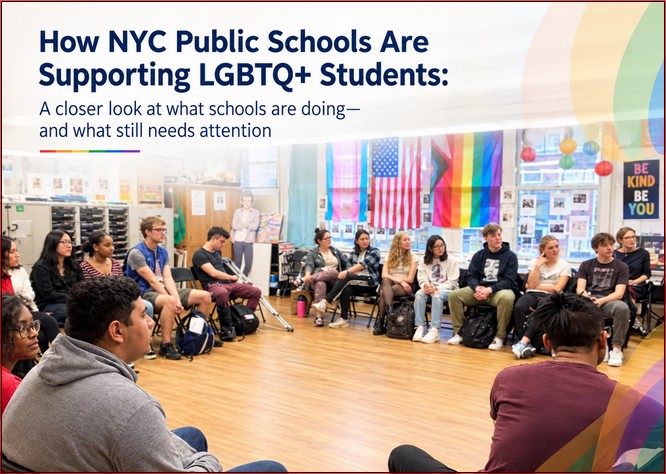
One important example is the Gender and Sexuality Alliance (GSA). NYCPS describes GSAs as student clubs where students can meet, support one another, discuss issues related to sexual orientation and gender identity, and work to reduce discrimination. These clubs are also open to allies and children of LGBTQ+ parents. ()
The scale of the program is significant. In February 2025, NYCPS reported that more than 1,000 students and staff attended its seventh annual GSA Summit. The event brought together students and educators from across the city. ()
For a student who feels isolated, a GSA can be much more than an extracurricular club. It can provide a place to meet other students who understand their experiences and to find adults who are willing to help.
But there is an important limitation: having a citywide GSA program does not mean that every student has the same level of access to LGBTQ+ support.
The quality of the experience can depend on whether a particular school has an active GSA, a supportive faculty adviser, a responsive counselor, and school leadership that takes the issue seriously.
This is one of the areas where NYCPS could provide more publicly available information. The central system explains how GSAs can be created and supported, but it is harder for the public to determine how consistently active these organizations are across all schools.
Are Teachers Being Prepared?
Another important part of the picture is teacher education.
NYCPS has an OUT for Safe Schools initiative. According to NYCPS, participating staff receive training in LGBTQ+ concepts, policies, and resources and can then wear a badge identifying themselves as trained, trusted adults for LGBTQ+ students. ()
The school system also provides professional-development materials through its LGBTQ+ Supports resources and has developed LGBTQ+-inclusive curriculum materials.
This is a positive step because teachers are often the first adults to notice when a student is being bullied, excluded, or struggling.
However, there is a difference between having training available and ensuring that every relevant employee receives meaningful training.
NYCPS publicly describes the training and resources that are available, but the information is less clear about the percentage of teachers, principals, counselors, and other school employees who have completed LGBTQ+-specific training across the entire system.
That is an important gap in measuring effectiveness.
A school can have excellent policies, but if teachers do not know how to respond when a student reports harassment—or do not understand the school’s gender-inclusion procedures—the policy may not have the intended effect.
What About Parents?
Parents are another important part of the equation.
NYCPS provides families with information about LGBTQ+ policies and resources. Its 2025–26 LGBTQ+ Resource Guide is specifically described as a resource for students, staff members, and caregivers. ()
NYCPS also directs families toward community organizations that provide LGBTQ+-related counseling, advocacy, health, and family support.
The Respect for All program provides additional resources for families dealing with bullying and harassment. ()
Still, parent education appears to be an area where NYCPS could do more at the individual-school level.
Providing an online resource is useful, but parents may also need opportunities to ask questions, understand school policies, learn how to support their children, and know where to turn when a problem occurs.
Schools could make this easier by holding periodic family information sessions and providing information in the languages commonly spoken in their school communities.
Is LGBTQ+ Inclusion Part of the Classroom?
NYCPS says that curriculum should be both a “window and a mirror”: students should learn about experiences different from their own, while LGBTQ+ students should also be able to see themselves represented in what they learn. ()
The school system points to resources including LGBTQ+ history materials, books by LGBTQ+ authors, teacher-created resources, and the Hidden Voices curriculum series.
This is an important part of inclusion because supporting LGBTQ+ students is not only about preventing bullying. It is also about whether students encounter an environment where different identities and families are treated as a normal part of society.
Again, however, implementation is the difficult part. A citywide curriculum resource does not necessarily mean that every classroom uses it.
What Does the Evidence Tell Us?
Independent research gives some context for why these efforts matter.
GLSEN’s national school-climate research has found that LGBTQ+ students’ experiences vary considerably between schools. Its research has also found that younger LGBTQ+ students, particularly middle-school students, can experience less supportive school climates and have less access to LGBTQ+-related resources than high-school students. ()
It is important not to present this national research as NYC-specific data. It tells us about patterns among LGBTQ+ students nationally, rather than proving that every one of those patterns exists in NYCPS.
For NYC specifically, the school system already has an important tool for measuring school climate: the NYC School Survey, which collects feedback from students, families, teachers, and staff. NYCPS says the survey is used by school leaders to understand how members of their school communities view their schools and to support school improvement. ()
A useful next step would be making LGBTQ+ students’ experiences more visible in school-climate analysis while protecting student privacy.
So, Is NYCPS Doing Enough?
The answer is not simply yes or no.
At the central level, NYCPS has put considerable infrastructure in place. There are explicit nondiscrimination policies, Respect for All, transgender and gender-expansive student guidelines, GSAs, staff training, inclusive curriculum resources, family resources, and community partnerships. ()
The challenge is making sure these policies are experienced consistently by students in individual schools.
There are three areas that deserve particular attention.
First, implementation. NYCPS should be able to show whether schools are actually putting the central policies into practice.
Second, teacher preparation. It would be useful to know how many educators have received LGBTQ+-specific training and whether that training is repeated rather than treated as a one-time activity.
Third, family engagement. NYCPS has good resources for families, but individual schools could do more to bring parents into the conversation.
The system should also pay particular attention to middle-school students. National research suggests that younger LGBTQ+ students can have fewer supportive resources than high-school students. ()
What Could Be Improved?
A few relatively practical steps could make NYCPS’s existing approach stronger:
1. Measure the student experience, not just the existence of programs.
NYCPS could regularly examine whether LGBTQ+ students feel safe, respected, included, and able to identify a trusted adult.
2. Make teacher training easier to measure.
The city should publish basic information about participation in LGBTQ+-inclusive professional development.
3. Strengthen parent outreach.
Schools could offer short, accessible information sessions for families and provide materials in multiple languages.
4. Pay particular attention to middle schools.
Younger LGBTQ+ students should not have to wait until high school to find supportive communities.
5. Give students a stronger voice.
Students involved in GSAs and other student organizations can provide valuable information about what is actually happening inside their schools.
6. Be transparent about implementation.
NYCPS already has a large policy framework. The next step is showing the public how consistently that framework is being put into practice.
Final Takeaway
NYC Public Schools has clearly recognized that LGBTQ+ students need more than a general statement about equality. The system has created specific policies, programs, student groups, training opportunities, curriculum resources, and family supports.
The more difficult question is what happens at the school level.
A student may attend a school with an active GSA, supportive teachers, a trained counselor, and a principal who understands the city’s policies. Another student may attend a school where those supports are less visible or less active.
That is why the next phase of NYCPS’s work should focus on consistency and accountability.
The goal should not simply be for every school to have the right policies on paper. The goal should be for LGBTQ+ students across New York City to experience those policies in their everyday school lives—to know where they can get help, to have adults they trust, to feel safe from harassment, and to see their identities treated with respect in the classroom.
NYCPS has built much of the framework needed to achieve that. The remaining challenge is making sure the framework works equally well at the school level.