
By Afifa Khanam
For generations of New York high school students, the path to a diploma has included a familiar hurdle: the Regents examinations. Students have spent months preparing for the tests, teachers have devoted valuable instructional time to Regents preparation, and for some students, a single examination has stood between them and a high school diploma.
That system is now beginning to change.
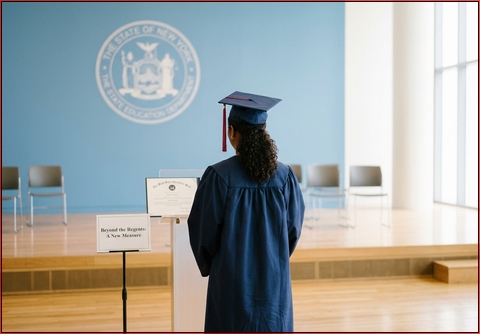
New York State is moving toward a new graduation model under NY Inspires, a multi-year effort to redefine what a high school diploma should represent. Beginning with students graduating in 2028, students will no longer have to pass a prescribed set of Regents examinations to earn a diploma. Regents exams will not disappear; rather, they will become one of several ways students can demonstrate mastery of state learning standards. The state is also moving toward one New York State high school diploma, with seals and endorsements available to recognize additional accomplishments.
The change could be particularly meaningful for students who have demonstrated what they know in the classroom but have struggled to demonstrate it on a high-stakes examination.
For English language learners, language can become an additional test
Among those students are English language learners, or multilingual learners, who may understand the concepts being taught in school but still be developing the academic English necessary to demonstrate that knowledge on a demanding standardized test.
This distinction matters.
Learning conversational English is not the same as mastering the complex language of academic subjects. Students must learn to read dense informational texts, understand unfamiliar vocabulary, analyze literature, interpret questions, construct evidence-based arguments, and write clearly under time pressure. These skills develop over time.
Research summarized by the National Academies has found that it can take five to seven years for English learners to develop the English necessary to participate fully in a school’s curriculum without additional linguistic support. The research also notes that academic language becomes increasingly demanding as students move through school.
More recent research involving more than 54,000 English learners similarly found that half of the students in the study reached English proficiency in about five years, while literacy skills—particularly writing—developed more slowly than oral language skills.
For an immigrant student who enters a New York high school in ninth or 10th grade, this creates a difficult timeline. The student may have only a few years to acquire sophisticated academic English while simultaneously completing the same coursework and graduation requirements as students who have been educated in English throughout their schooling.
The problem becomes particularly visible on the English Language Arts Regents.
A student may understand a historical event, a scientific concept, or a literary theme. The student may participate successfully in class discussions, complete projects, and demonstrate growth through classroom assignments. But a high-stakes examination that requires reading complex passages and producing written responses within a limited period of time can measure both content knowledge and English-language proficiency.
That does not mean the student lacks academic ability. It means the assessment may capture only part of the student’s knowledge and skills.
The new approach gives schools more opportunities to look at multiple forms of evidence. NYSED says districts and schools will develop assessment strategies using sources that can include classroom assessments, student work, performance-based learning experiences, educator observations, and state assessments.
For multilingual learners, that could mean demonstrating learning through a research project, presentation, writing portfolio, performance task, classroom work, or other evidence—rather than having one examination determine whether the student is eligible for a diploma.
Moving from one test to a broader picture
The strongest argument for the new system is not simply that Regents exams create anxiety. It is that a single examination may provide an incomplete picture of a student’s readiness for college, employment, and adult life.
The state says its new vision is intended to emphasize skills such as critical thinking, communication, problem solving, and the ability to apply knowledge. The Portrait of a Graduate is part of that broader effort.
There is an important educational principle behind this shift: students should have meaningful opportunities to demonstrate what they know and can do.
A student who struggles with a three-hour standardized examination may nevertheless be an excellent writer over an extended period, a capable researcher, an effective public speaker, a creative problem solver, or a successful participant in a work-based learning experience.
The new system could therefore encourage schools to make learning more authentic. Instead of asking students primarily to prepare for an examination, schools could place greater emphasis on research, writing, presentations, internships, community service, projects, and other performance-based experiences. Such experiences can also provide teachers with a richer understanding of how students learn.
For students who experience severe test anxiety, removing the diploma as the consequence of failing a particular Regents examination could also reduce some of the psychological pressure surrounding graduation.
But reducing the pressure of a high-stakes test does not automatically guarantee better learning. The quality of the alternatives will matter enormously.
The question New York must answer: What will replace the common standard?
This is where the promise of the new system meets its greatest challenge.
The Regents system has provided something that is easy to understand: students across New York have been expected to meet common state standards and, traditionally, demonstrate their achievement through common examinations.
A performance-based system can produce a richer picture of student learning—but it can also create inconsistency if schools use substantially different expectations for demonstrating proficiency.
One school might require an extensive research project, oral presentation, and portfolio. Another might rely primarily on classroom grades. A third might create a rigorous performance assessment with a demanding rubric. If all three experiences result in the same diploma, parents and colleges may reasonably ask whether the diploma represents the same level of achievement everywhere.
This concern is particularly important for students from historically underserved communities.
If graduation expectations become too dependent on local school policies, the student experience could vary according to the school a young person happens to attend. A well-resourced school may have the staff, technology, partnerships, and professional development necessary to build sophisticated performance-based assessments. Another school may have fewer resources.
That could unintentionally create a new inequity while trying to eliminate an old one.
New York State appears to recognize this concern. NYSED says schools will continue teaching to New York State learning standards, while the state will maintain statewide assessments required under federal law. The department also says it is developing statewide accountability assessments designed to provide comparable evidence of student achievement.
The challenge will be making sure those safeguards are strong enough.
A diploma should mean something everywhere.
The debate, therefore, should not be framed simply as Regents versus no Regents.
The more important question is, how can New York create a graduation system that is both flexible enough to recognize different ways of learning and rigorous enough to ensure that a diploma means essentially the same thing across the state?
For English language learners, the answer could be especially consequential.
A multilingual student should have a genuine opportunity to demonstrate academic knowledge while continuing to develop English. At the same time, schools cannot lower expectations for students because they are learning English. The goal should be to maintain rigorous academic standards while providing multiple legitimate ways for students to demonstrate mastery.
That distinction is critical.
Removing the Regents as a graduation requirement should not mean removing accountability. It should mean changing what accountability looks like.
New York’s new system could give teachers greater freedom to assess students through multiple measures and could give students more than one opportunity to demonstrate their abilities. It could also reduce the possibility that an English learner spends years working toward a diploma only to be stopped by a single examination in a language he or she is still mastering.
But flexibility must be accompanied by transparency.
The state will need clear learning standards, common definitions of proficiency, credible assessment practices, meaningful oversight, and comparable expectations across schools. Teachers will need professional development and time to design high-quality performance assessments. Families will need to understand exactly what students must accomplish to graduate. Colleges and employers will need confidence that the new diploma represents meaningful preparation.
The Regents may no longer be the gatekeeper to a diploma. But the disappearance of one common test makes the question of what counts as evidence of learning even more important.
For New York’s English learners, students with disabilities and other young people who have historically struggled with high-stakes testing, the new system could open a door that the Regents sometimes kept closed.
Whether that door leads to greater equity—or simply creates different standards from school to school—will depend on what New York builds on the other side.
