Senior Correspondent, Dhaka:
Bangladesh has sought Bhutan’s support for revitalizing the South Asian Association for Regional Cooperation (SAARC), adding a regional dimension to Dhaka’s renewed engagement with its neighbors.
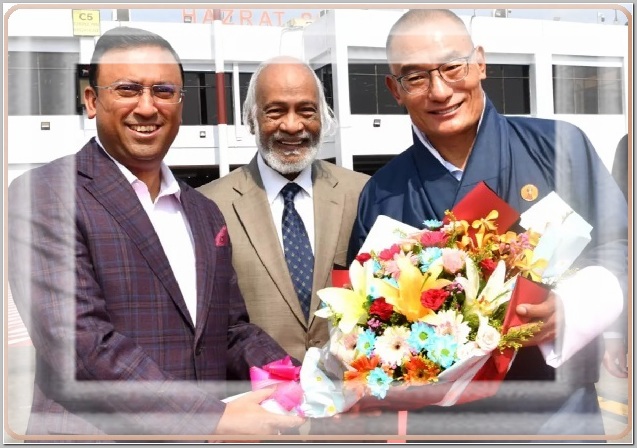
The issue was raised during Bhutanese Prime Minister Dasho Tshering Tobgay’s brief transit stopover in Dhaka on Friday. Local Government, Rural Development, and Cooperatives Minister Dr. Abdul Moyeen Khan and State Minister for Foreign Affairs Humaiun Kobir received Tobgay at Hazrat Shahjalal International Airport and conveyed greetings from Prime Minister Tarique Rahman.
During the interaction, the Bangladeshi ministers referred to the vision of former president Ziaur Rahman for a prosperous South Asia and requested Bhutan’s support for revitalizing SAARC for the collective benefit of the region and its people. SAARC, established in 1985, brings together Bangladesh, Bhutan, India, Maldives, Nepal, Pakistan, and Sri Lanka, along with Afghanistan.
The appeal comes as Bangladesh has recently raised the issue of SAARC revitalization in its diplomatic engagement with Bhutan. On September 16, Humaiun Kobir made a similar request during a meeting with Bhutanese Ambassador Dasho Karma Hamu Dorjee, indicating that the matter is becoming part of Dhaka’s broader regional diplomatic agenda.
The Dhaka-Timbu discussion also had an economic component. Bangladesh expressed interest in contributing professionals and skilled and semi-skilled workers to Bhutan’s Gelephu Mindfulness City, a major development initiative envisioned as an economic hub.
The two sides also discussed bilateral issues and highlighted longstanding relations, with Bhutan being the first country to recognize Bangladesh in 1971. Tobgay remained at the airport’s VVIP lounge for about an hour before departing for Germany.
The brief encounter therefore combined regional cooperation with practical bilateral interests, while Bangladesh’s repeated call for SAARC revitalization indicates an effort to place regional connectivity and cooperation higher on its diplomatic agenda.