Sadik Sagar, Dhaka:
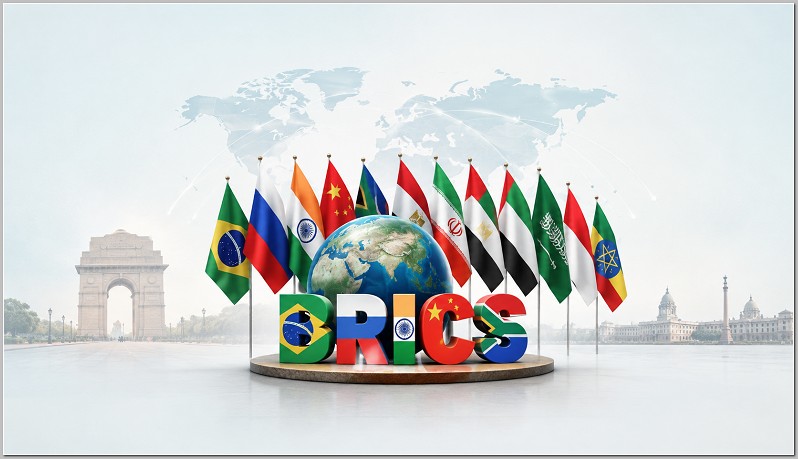
The 18th BRICS Summit in New Delhi is bringing together leaders and senior representatives from an increasingly diverse grouping, reflecting the bloc’s expanding geographic and strategic reach. The gathering comes at a particularly sensitive moment, with wars in West Asia and Ukraine intensifying competition among major powers and renewed debate over the distribution of influence in global institutions.
Among the most closely watched participants are Chinese President Xi Jinping and Russian President Vladimir Putin. Xi’s presence carries particular weight as it marks his first visit to India since the deadly 2020 border clashes. Although unresolved differences remain over the boundary, China’s relationship with Pakistan and the bilateral trade imbalance, Beijing continues to promote BRICS as a platform for a more multipolar international order and greater representation for developing countries.
Putin’s participation carries a different strategic significance. With Russia facing extensive Western sanctions since its 2022 invasion of Ukraine, BRICS provides Moscow with a platform to maintain relationships with countries outside the Western sanctions regime. At the same time, his presence highlights the complexity of India’s strategic calculations. New Delhi continues to rely on Russia for important defence and energy links while simultaneously deepening relations with the United States, Europe, Japan and Gulf countries.
The newer members add another layer to the summit’s geopolitical equation. Iranian President Masoud Pezeshkian represents a country central to regional energy and connectivity, particularly through its potential links between South Asia, Central Asia, the Middle East, and Europe. Egypt’s Abdel Fattah el-Sisi brings the strategic significance of the Suez Canal, while Indonesia’s Prabowo Subianto strengthens BRICS’ presence in Southeast Asia and adds the weight of a large emerging economy rich in key commodities.
South Africa and Ethiopia reinforce the bloc’s African dimension, while the UAE and Saudi Arabia add the economic and strategic weight of the Gulf. The UAE’s role is linked to energy, finance, investment, and logistics, whereas Saudi Arabia brings major influence in global energy markets, although questions remain over its formal BRICS membership status.
Taken together, the participants demonstrate both the strength and complexity of an expanded BRICS. The grouping now connects major economies, energy producers, and strategically positioned states across Asia, Africa, the Middle East and Latin America. Its growing diversity gives it greater geopolitical reach but also means that its members must navigate substantially different national interests. The New Delhi summit therefore matters not simply because of who attends, but because it offers a measure of how effectively an expanded BRICS can translate its collective weight into greater influence over the global order.