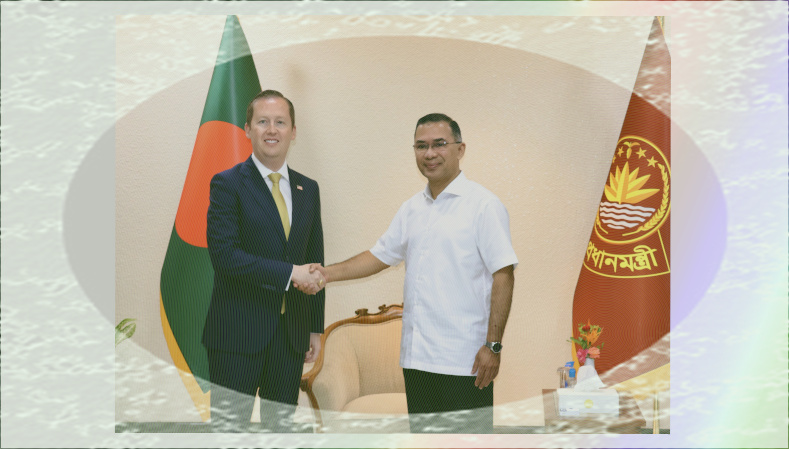
Anwar Shahadat, New York: U.S. Special Envoy for South and Central Asia Ambassador Sergio Gor concluded a three-day visit to Bangladesh on Friday. The visit reaffirmed Washington’s commitment to strengthening bilateral relations at a time when South Asia is gaining greater strategic importance in the Indo-Pacific.
According to the U.S. Embassy in Dhaka, Ambassador Gor met Prime Minister Tarique Rahman and Foreign Minister Khalilur Rahman. Their discussions focused on the political and economic dynamics shaping U.S.-Bangladesh relations. The envoy also visited the Rohingya refugee camps in Cox’s Bazar. The Embassy said the visit reflected the breadth and depth of the partnership between the two countries.
While the Embassy emphasized diplomacy, economic cooperation, and humanitarian engagement, the timing of the visit carries broader strategic significance. Bangladesh has become increasingly important as geopolitical competition between the United States and China intensifies across the Indo-Pacific.
Washington now views Bangladesh as more than a major apparel exporter or humanitarian partner. Its strategic location on the Bay of Bengal makes it an important player in regional connectivity and maritime trade. Bangladesh is also becoming increasingly relevant to supply-chain resilience, digital infrastructure, and clean-energy cooperation.
The visit also comes amid growing discussions surrounding PACSILICA (Partners for a Connected and Sustainable Indo-Pacific). The initiative seeks to promote sustainable infrastructure, digital connectivity, clean energy, resilient supply chains, and high-standard investment across the Indo-Pacific. Although the Embassy announced no formal role for Bangladesh, Ambassador Gor’s meetings have strengthened expectations that Washington sees Dhaka as a potential future partner.
Participation in PACSILICA-related initiatives could create new opportunities for Bangladesh. The country could attract diversified investment and improve regional connectivity. It could also strengthen renewable-energy cooperation, modernize logistics networks, and integrate more deeply into the Indo-Pacific economy.
The visit also reflects Washington’s broader regional strategy. The United States is strengthening ties with countries that pursue balanced foreign policies rather than exclusive strategic alignments. Bangladesh has consistently maintained constructive relations with the United States, China, India, Japan, and European partners. That balanced approach has become one of its major diplomatic strengths.
China nevertheless remains Bangladesh’s largest trading partner. Beijing has financed major infrastructure projects through the Belt and Road Initiative. Chinese companies have invested in bridges, power plants, transport projects, and industrial development. Defense cooperation between Dhaka and Beijing has also expanded over the past two decades.
Rather than replacing China’s role, the United States appears to be offering Bangladesh additional strategic and economic options. Washington has increasingly emphasized transparent investment, private-sector partnerships, clean-energy cooperation, digital technology, and resilient supply chains. The objective is to help regional partners diversify their international relationships without becoming overly dependent on any single country.
Another important element of Ambassador Gor’s visit was his trip to Cox’s Bazar. The visit reaffirmed continued U.S. support for Rohingya refugees and host communities. The United States remains the largest humanitarian donor to the Rohingya response. Washington continues to support efforts for the safe, voluntary, dignified, and sustainable return of refugees to Myanmar.
Overall, Ambassador Gor’s visit highlights the evolution of U.S.-Bangladesh relations. Bilateral cooperation is expanding beyond traditional diplomacy. It now includes economic resilience, sustainable connectivity, technology partnerships, and Indo-Pacific stability.
For Bangladesh, this presents significant opportunities. The country seeks greater trade, investment, technology transfer, and infrastructure development. At the same time, it continues to preserve its long-standing policy of maintaining constructive relations with all major powers. If managed carefully, Bangladesh could benefit from growing international competition while protecting its strategic autonomy.
No major agreements were announced during the visit. However, the diplomatic message was clear. The United States considers Bangladesh an increasingly important partner in the Indo-Pacific. How Dhaka balances closer cooperation with Washington while maintaining strong ties with Beijing and other regional partners will remain one of the country’s most important foreign-policy challenges in the coming years.