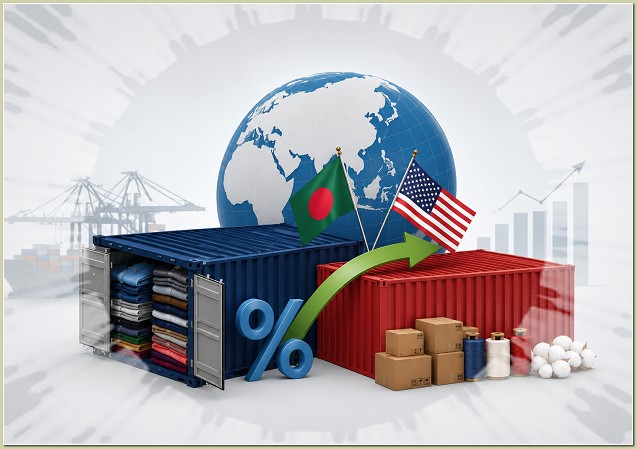
The effective tariff on garment exports to the US remains at 25.62 percent, unchanged from the previous temporary tariff regime.
Special Correspondent, Dhaka:
Bangladesh’s export sector has avoided a fresh shock after the US 10% tariff on Bangladesh exports was retained under a new legal framework, replacing the temporary tariff that expired after 150 days. While the measure does not increase the effective duty on Bangladeshi exports, it underscores Washington’s evolving trade strategy and highlights the need for Bangladesh to strengthen labor compliance and diversify its export markets.
The tariff, imposed under Section 301(b) of the US Trade Act of 1974, targets countries that the US believes have not done enough to prevent imports of goods produced using forced labor. Bangladesh has been placed in the lower 10 percent tariff category alongside 17 other countries, while major apparel-exporting competitors such as China, Vietnam and Thailand face a higher 12.5 percent rate. This distinction preserves Bangladesh’s relative competitiveness in the crucial US apparel market.
For Bangladesh’s ready-made garment (RMG) industry, the immediate impact appears limited. The effective tariff on garment exports to the US remains at 25.62 percent, unchanged from the previous temporary tariff regime. Commerce Minister Khandaker Abdul Muktadir and BGMEA leaders have emphasized that the latest measure merely replaces the earlier tariff under a different legal authority rather than introducing an additional financial burden.
However, the broader implications deserve attention. Although the US 10% tariff on Bangladesh exports leaves the overall tariff unchanged, Bangladeshi exporters continue to face higher costs compared to the pre-2025 period, when garments entered the US market with a duty of around 15.62 percent. Industry analysts caution that US buyers may seek to transfer part of the tariff burden to suppliers, potentially squeezing exporters’ profit margins at a time when production costs remain elevated due to rising wages, energy expenses and global economic uncertainty.
The policy also reflects a significant shift in US trade strategy. Following the Supreme Court’s decision striking down President Donald Trump’s reciprocal tariffs, Washington has adopted alternative legal mechanisms to maintain its protectionist trade agenda. The Section 301 approach links market access more directly with labor standards, making compliance an increasingly important element of international trade competitiveness.
There is, however, a positive opportunity. The proposed three-year Tariff-Rate Quota (TRQ), which could exempt products manufactured using US cotton and textile inputs from Section 301 tariffs, may create additional incentives for Bangladesh to integrate more closely with US supply chains. If implemented, it could partially offset tariff costs and strengthen bilateral trade.
Bangladesh exported goods worth $9.04 billion to the US in FY2025-26, with garments accounting for $7.74 billion. As the US 10% tariff on Bangladesh exports remains in place, protecting this market requires more than tariff negotiations. Continued improvements in labor rights, supply chain transparency, product diversification and trade diplomacy will be essential to sustaining export growth in an increasingly compliance-driven global trading environment.