Staff Correspondent, Dhaka:
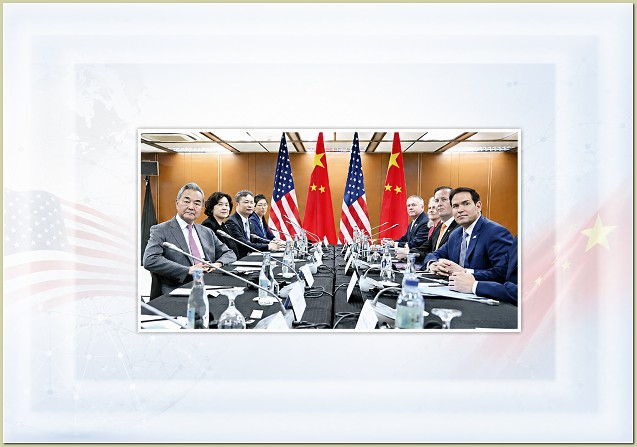
The latest meeting between US Secretary of State Marco Rubio and Chinese Foreign Minister Wang Yi in Manila signals that Washington and Beijing are attempting to prevent their strategic rivalry from escalating into direct confrontation. While the two sides remain divided on issues ranging from trade and Taiwan to the South China Sea, the discussions reflected a shared recognition that sustained dialogue is essential for managing competition between the world’s two largest economies.
Speaking after the 90-minute meeting on the sidelines of the ASEAN Foreign Ministers’ Meeting, Rubio said both countries must identify areas of cooperation ahead of Chinese President Xi Jinping’s expected visit to Washington in September. His remarks suggest that despite profound disagreements, both governments are seeking to establish a more predictable framework for engagement.
The talks come at a delicate moment in bilateral relations. Although a temporary trade understanding has helped ease economic tensions, geopolitical disputes continue to dominate the relationship. Taiwan remains the most sensitive issue, while maritime confrontations in the South China Sea continue to test regional stability. Rubio’s criticism of China’s actions in the disputed waters, coupled with his concern over the recent confrontation between Chinese and Philippine maritime forces, underscores Washington’s continued commitment to its regional allies.
Notably, Rubio emphasized that maintaining communication is a strategic necessity rather than a diplomatic luxury. Given the enormous influence of both countries on global trade, investment, technology and security, a complete breakdown in dialogue would carry significant international consequences.
The Manila meeting also demonstrates ASEAN’s growing importance as a venue for major power diplomacy. As competition between Washington and Beijing increasingly shapes the Indo-Pacific, Southeast Asian nations are expected to play an increasingly significant role in facilitating dialogue while balancing relations with both powers.
Ultimately, the challenge for both governments is no longer whether differences exist—they clearly do—but whether those differences can be managed responsibly. The success of Xi’s anticipated Washington visit may therefore become an important indicator of whether the current fragile stability can evolve into a more durable framework for strategic coexistence.