
Staff Correspondent, Dhaka:
Indian Home Minister Amit Shah’s visit to the India-Bangladesh border on Saturday has reinforced New Delhi’s growing emphasis on strengthening security along the strategically vital Siliguri Corridor, signaling a broader effort to modernize border management through advanced technology, infrastructure development and administrative reforms amid evolving regional security dynamics.
The visit focused on the Siliguri Corridor—commonly known as the “Chicken’s Neck”—a narrow strip of land that connects India’s northeastern states with the rest of the country. Surrounded by Bangladesh, Nepal, Bhutan and lying close to China’s border, the corridor is widely regarded as one of India’s most strategically sensitive regions due to its geopolitical importance and vulnerability to security disruptions.
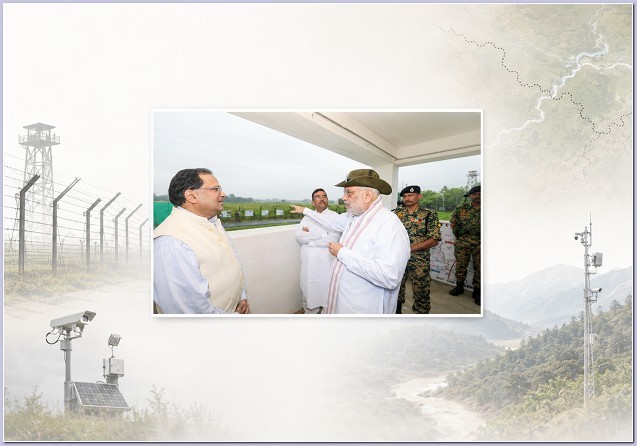
During his inspection of the Border Security Force (BSF) installations at the Jumagach Border Outpost near Siliguri, Shah reviewed a range of indigenous surveillance technologies aimed at strengthening border monitoring and improving operational response. These included an infiltration warning system, a radio-based fence breach detection mechanism, infrared alarm systems for difficult terrain, gate management software and a newly designed smart border fence.
According to Indian officials, the radio-based detection system can instantly alert security personnel if any section of the border fence is tampered with, while infrared sensors enhance surveillance in areas where conventional monitoring remains challenging. The deployment of such technologies reflects India’s increasing reliance on integrated surveillance systems to address cross-border threats more efficiently.
Shah also laid the foundation stone for several BSF infrastructure projects, including upgraded facilities for border outposts and a four-kilometer stretch of new border fencing in West Bengal. The projects are intended to improve operational readiness and strengthen monitoring along vulnerable sections of the international border.
Beyond the inspection of security infrastructure, the visit highlighted India’s broader strategy of combining technological innovation with expanded physical infrastructure to create a more comprehensive border management framework. The Centre has increasingly prioritized smart surveillance, faster response mechanisms and improved coordination among security agencies as part of its evolving national security doctrine.
The timing of the visit is significant as India continues to strengthen border security amid persistent concerns over illegal infiltration, transnational crime, smuggling and other cross-border challenges. While Indian authorities have consistently described these measures as necessary to safeguard national security, the modernization drive also reflects a wider regional trend of enhancing border resilience through technology-driven solutions.
The Siliguri Corridor has long occupied a central place in India’s strategic planning because of its narrow geography and its role as the only land link between mainland India and the country’s eight northeastern states. Any disruption in this corridor could have significant implications for military logistics, trade connectivity and civilian movement, making its security a longstanding priority for New Delhi.
Following the border inspection, Shah chaired a series of high-level meetings at Uttarkanya in Siliguri to review regional security, the implementation of India’s new criminal laws and amendments to birth and death registration regulations. The discussions underscored the government’s integrated approach to governance, linking internal security, legal reforms and border administration under a unified policy framework.
Analysts view the visit as part of India’s continuing efforts to reinforce strategic preparedness along its eastern frontier while adapting border management to emerging technological and geopolitical realities. As South Asia experiences shifting security dynamics and increasing emphasis on critical infrastructure protection, India’s investment in smart border technologies and operational capacity along the Bangladesh frontier is expected to remain a key component of its long-term national security strategy.